
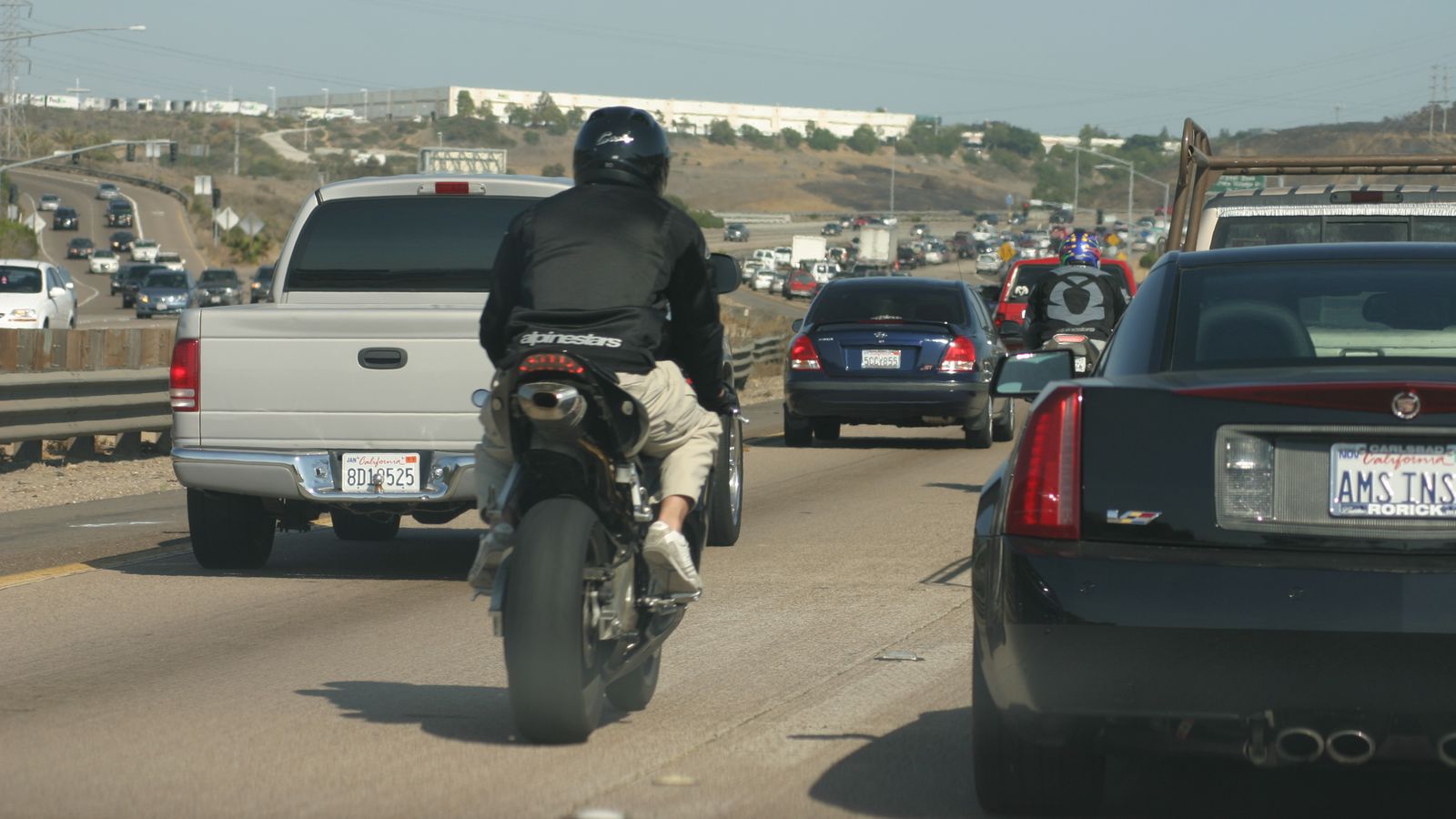

The short version
- TrippApps thinks lane splitting and lane filtering should be legal in every state, because a motorcycle held at the back of stopped traffic is parked in the one spot on the road its rider can do nothing about.
- Almost nowhere allows it yet. 3 of 51 U.S. jurisdictions let you pass between lanes of moving traffic. 6 let you move up between lanes of stopped traffic. Five of those six wrote a speed cap into the statute; California left it to CHP guidance, which sets no number.
- Helmets work; mandating them is a separate argument. NHTSA estimates a helmet is 37 percent effective at preventing rider deaths and 41 percent for passengers. Whether the state should require one is a different question, and we do not settle it here.
- The rules flip at the state line. Ride south out of Minnesota into Iowa and three of the four change at once: splitting becomes illegal, filtering becomes illegal, and the helmet requirement vanishes altogether — Minnesota requires one of riders under 18 and of anyone riding on a permit, Iowa of nobody at all.
- On a well-planned trip you are rarely in that traffic at all. A two-lane road has no second lane to split, and a city you cross before or after the rush has nothing to filter past.
Where the law stands
as of September 14, 2026What these four things are
Lane splitting
Riding between two lanes of moving traffic, in the same direction, usually on a multi-lane road.
Lane filtering
Moving between lanes of stopped traffic to reach the front, typically at a light, then pulling away first.
Two abreast
Two motorcycles sharing one lane side by side. Most places allow it; a few require single file.
Helmet laws
Whether the state requires a helmet for every rider, only for some (by age, license tenure or insurance), or not at all. Whether to wear one is a separate question, and we answer it below.
Check the states on your route
Add the states or provinces you will ride through, in order — tap them on the map, or tick them off the list. You get a card per jurisdiction, a flag at every border where a rule changes, and the tables below narrow to your route.
Tap a state to add it; tap again to remove. Scroll or pinch to zoom, drag to pan — the small Northeastern states are easy at two or three times zoom.
Tick a box to add it. Enter adds the only match.
No state or province matches that.
Your route is empty. Pick a state to start.
Every U.S. state and DC
Read across a row for the four rules; each cell links the section we read. Use the arrows in the column headers to filter — every state with no helmet law, say — and the table follows the route you picked above. A verify locally mark means we could only confirm it from an official summary, not the code itself.
| State | Helmet | Lane splitting | Lane filtering | Two abreast |
|---|---|---|---|---|
| Alabama verify locally | Required, all ridersEvery motorcycle or motor-driven-cycle operator and passenger must wear an approved protective helmet; riders in an enclosed cab or on an autocycle are exempt. Ala. Code § 32-5A-245 | Not legalState law bars operating a motorcycle between lanes of traffic or between adjacent rows of vehicles. Ala. Code § 32-5A-242(c) | Not legalThe same between-lanes ban applies regardless of whether traffic ahead is moving or stopped at a light. Ala. Code § 32-5A-242(c) | AllowedTwo motorcycles may share one lane side by side, but no more than two. Ala. Code § 32-5A-242 |
| Alaska verify locally | Required for someRiders under 18 must wear a DOT-type-compliant helmet, and so must any adult rider who doesn't hold a motorcycle license or endorsement; licensed adult riders 18 and up can go without one. AS 28.35.245 | Not legalA motorcycle can't be driven between adjacent lanes or rows of vehicles, whether that traffic is moving or stopped. 13 AAC 02.427 | Not legalThe same rule that bans lane splitting also bans filtering to the front at a stoplight — there's no carve-out for stopped traffic. 13 AAC 02.427 | AllowedTwo motorcycles can share one lane side by side if both riders agree; three or more abreast is not allowed. 13 AAC 02.427 |
| Arizona | Required for someOnly riders and passengers under 18 must wear a helmet; adult riders can go without one. A.R.S. § 28-964 | Not legalA motorcycle can't be ridden between lanes of traffic or between rows of vehicles, except under the specific filtering exception for stopped traffic. A.R.S. § 28-903 | LegalA two-wheeled motorcycle may pass a vehicle stopped in its own lane and may ride between lanes to do it, on a street with at least two same-direction lanes and a limit of 45 mph or less, at no more than 15 mph. A.R.S. § 28-903(F) | AllowedTwo motorcycles may share one lane side by side; more than two abreast is not allowed. A.R.S. § 28-903 |
| Arkansas verify locally | Required for someOnly operators and passengers under 21 must wear a helmet; everyone, at any age, still needs eye protection. Ark. Code Ann. § 27-20-104 | Not legalArkansas has no lane-splitting statute, but the general rule that every vehicle must stay within one marked lane makes riding between lanes of moving traffic a violation. Ark. Code Ann. § 27-51-302 | Not legalThe same single-lane rule used against splitting applies to moving up between stopped cars to reach the front, since it carves out no exception for stopped traffic. Ark. Code Ann. § 27-51-302 | Not addressedArkansas has no statute that specifically allows or bans two motorcycles riding side by side in one lane. Ark. Code Ann. § 27-51-302 (no motorcycle exception found); motorcycle chapter §§ 27-20-101 to -120 has no equivalent provision |
| California | Required, all ridersEvery motorcycle operator and passenger must wear a DOT-compliant helmet, with no age exemption. Cal. Veh. Code § 27803 | LegalRiding a two-wheeled motorcycle between rows of moving vehicles in the same lane is lawful; the section defines the practice and the CHP publishes the safety guidance rather than a statutory speed cap. Cal. Veh. Code § 21658.1 | LegalThe statutory definition of lane splitting covers rows of stopped vehicles as well as moving ones, so filtering to the front at a light is lawful under the same section. Cal. Veh. Code § 21658.1 | Not addressedNo California statute says whether two motorcycles may ride side by side within one lane. Cal. Veh. Code § 21658 (no motorcycle two-abreast provision) |
| Colorado | Required for someOnly riders and passengers under 18 must wear a helmet; adults can go without one. C.R.S. § 42-4-1502(4.5) | Not legalA motorcycle can't pass another vehicle within the same lane or ride between lanes of traffic, except under the lane-filtering exception for fully stopped traffic. C.R.S. § 42-4-1503(3)(a) | LegalA two-wheeled motorcycle may pass a stopped vehicle in its own lane at 15 mph or less when the vehicles in the adjacent same-direction lanes are stopped too and the lanes are wide enough, and must stop passing the moment traffic starts moving. C.R.S. § 42-4-1503(3)(b) | AllowedMotorcycles may ride two abreast in a single lane; more than two is not allowed. C.R.S. § 42-4-1503(1),(4) |
| Connecticut | Required for someOnly operators and passengers under 18 must wear an approved helmet; adult riders 18 and older are not required to wear one. Conn. Gen. Stat. § 14-289g | Not legalA motorcyclist is entitled to full use of a single lane and may not overtake within that lane or operate the motorcycle between lanes of traffic. Conn. Gen. Stat. § 14-289b(a)-(b) | Not legalThe same ban on operating a motorcycle 'between lanes of traffic' applies whether the surrounding traffic is moving or stopped. Conn. Gen. Stat. § 14-289b(b)(2) | AllowedUp to two motorcycles may ride side by side in one lane; operating more than two abreast is prohibited. Conn. Gen. Stat. § 14-289b(a) |
| Delaware | Required for someRiders and passengers age 19 or under must wear a helmet and eye protection, and anyone who received a motorcycle endorsement on or after July 30, 2023 must wear a helmet for their first two years of riding regardless of age. 21 Del. C. § 4185 | Not legalDelaware has no motorcycle-specific lane statute; the general rule that a vehicle stay within a single marked lane whenever practicable bars riding between lanes of moving traffic. 21 Del. C. § 4122(1) | Not legalThe same single-lane requirement applies whether traffic ahead is moving or stopped at a light. 21 Del. C. § 4122(1) | Not addressedNo Delaware statute addresses two motorcycles riding side by side in one lane. 21 Del. C. ch. 41 |
| District of Columbia | Required, all ridersEvery motorcycle or motor-driven-cycle operator and passenger must wear a Director-approved protective helmet; there is no age or insurance exception. 18 DCMR § 2215.3 | Not legalDC has no motorcycle-specific lane-splitting rule; the general requirement that a vehicle stay within one marked lane whenever practicable bars riding between lanes. 18 DCMR § 2201.6(a) | Not legalThe same single-lane rule applies whether the traffic ahead is moving or stopped at a light. 18 DCMR § 2201.6(a) | Not addressedNo DC regulation grants or bars two motorcycles riding side by side in one lane. 18 DCMR ch. 22 (no two-abreast provision) |
| Florida | Required for someRiders and passengers under 21 must wear an FMVSS-218 helmet; riders 21 or older may go without one if they carry at least $10,000 of medical-benefits insurance for crash injuries. Fla. Stat. § 316.211 | Not legalState law bars operating a motorcycle between lanes of traffic or between adjacent rows of vehicles. Fla. Stat. § 316.209(3) | Not legalThe same between-lanes ban applies regardless of whether traffic ahead is moving or stopped at a light. Fla. Stat. § 316.209(3) | AllowedTwo motorcycles may share one lane side by side, but no more than two. Fla. Stat. § 316.209(1),(4) |
| Georgia verify locally | Required, all ridersEvery motorcycle operator and passenger must wear a commissioner-approved protective helmet; riders in an enclosed cab/cart or on agricultural-only three-wheelers are exempt. O.C.G.A. § 40-6-315 | Not legalState law bars operating a motorcycle between lanes of traffic or between adjacent rows of vehicles. O.C.G.A. § 40-6-312 | Not legalThe same between-lanes ban applies regardless of whether traffic ahead is moving or stopped at a light. O.C.G.A. § 40-6-312 | AllowedTwo motorcycles may share one lane side by side, but no more than two. O.C.G.A. § 40-6-312 |
| Hawaii | Required for someOnly riders and passengers under 18 must wear a securely fastened safety helmet; every rider, at any age, needs eye protection unless the bike has a windscreen. Haw. Rev. Stat. § 286-81(e) | Not legalA motorcycle can't pass another vehicle within its lane, or ride between lanes of traffic or rows of vehicles. Haw. Rev. Stat. § 291C-153(b),(c) | Not legalThe same rule that bans splitting also bans filtering to the front of a stopped line — there's no stopped-traffic exception. Haw. Rev. Stat. § 291C-153(c) | AllowedMotorcycles may ride two abreast in one lane; more than two is not allowed. Haw. Rev. Stat. § 291C-153(a),(d) |
| Idaho | Required for someOnly riders under 18 must wear a helmet; adult riders can go without one. Idaho Code § 49-666 | Not legalIdaho has no motorcycle-specific lane-splitting law, but the general rule that every vehicle must stay in a single lane "as nearly as practicable" prohibits it. Idaho Code § 49-637 | Not legalThe same general single-lane rule applies at a stop — there's no carve-out letting a motorcycle filter to the front. Idaho Code § 49-637 | Not addressedNo Idaho statute says whether two motorcycles may share one lane side by side. Idaho Code tit. 49, ch. 6 (no two-abreast provision) |
| Illinois | No lawIllinois has no helmet requirement for motorcycle riders of any age; only eye protection (glasses, goggles, or a shield) is required. 625 ILCS 5/11-1404 | Not legalIllinois has no motorcycle-specific lane-splitting statute, but the general rule that every vehicle stay within one marked lane makes riding between lanes of traffic a violation. 625 ILCS 5/11-709(a) | Not legalThe same single-lane rule applies to filtering past stopped traffic, since no exception exists for stopped vehicles either. 625 ILCS 5/11-709(a) | Not addressedIllinois law explicitly lets two bicycles ride abreast in a lane, but there is no equivalent provision naming motorcycles. 625 ILCS 5/11-709(a); cf. 625 ILCS 5/11-1505.1 (bicycles/motorized pedal cycles only) |
| Indiana verify locally | Required for someOnly riders and passengers under 18 must wear protective headgear and eye protection; per Indiana BMV guidance, anyone riding on a motorcycle learner's permit must also wear a helmet. Ind. Code § 9-21-10-9 | Not legalIndiana’s motorcycle statute grants full lane use and a two-abreast allowance but has no explicit between-lanes ban; on a road with three or more marked lanes, the general rule that a vehicle stay as nearly as practicable within a single lane is what bars riding between lanes. Ind. Code § 9-21-8-11(1) | Not legalThe same single-lane requirement applies whether traffic ahead is moving or stopped at a light. Ind. Code § 9-21-8-11(1) | AllowedTwo motorcycles may share one lane side by side if both riders consent. Ind. Code § 9-21-10-6 |
| Iowa | No lawIowa has no helmet requirement for motorcycle riders of any age. Iowa Code ch. 321 (no helmet-use section exists) | Not legalState law flatly bans riding a motorcycle between lanes of traffic or between adjacent rows of vehicles. Iowa Code § 321.275(4) | Not legalThe same ban on riding between lanes covers moving up between stopped cars, since the statute names both moving and stationary rows of vehicles. Iowa Code § 321.275(4) | AllowedTwo motorcycles may ride side by side in one lane, but no more than two. Iowa Code § 321.275(4) |
| Kansas | Required for someOnly riders and passengers under 18 must wear a helmet meeting federal safety guidelines. K.S.A. § 8-1598(a) | Not legalState law bars passing another vehicle within the same lane and bars riding between lanes of traffic. K.S.A. § 8-1595(b),(c) | Not legalThe same section bars moving between adjacent lines or rows of vehicles, which covers stopped traffic too. K.S.A. § 8-1595(c) | AllowedMotorcycles may ride two abreast, but not more, in a single lane. K.S.A. § 8-1595(d) |
| Kentucky | Required for someRiders and passengers under 21, instruction-permit holders, and anyone who has held a motorcycle license less than one year must wear a helmet; there is no insurance-based exemption. KRS 189.285(3) | Not legalKentucky has no motorcycle-specific lane statute; on any road with 3+ marked lanes, the general rule that a vehicle stay within a single lane whenever practical bars riding between lanes. KRS 189.340(7)(a) | Not legalThe same single-lane requirement applies whether traffic ahead is moving or stopped at a light. KRS 189.340(7)(a) | Not addressedNo Kentucky statute addresses two motorcycles riding side by side; only bicycles have an explicit two-abreast rule. KRS 189.340(2)(c) |
| Louisiana | Required, all ridersEvery operator and passenger must wear an approved safety helmet with the chin strap fastened, regardless of age; only parade participants and certain autocycles are exempt. La. Rev. Stat. § 32:190 | Not legalRiding a motorcycle between lanes of traffic, or between adjacent lines or rows of vehicles, is banned outright. La. Rev. Stat. § 32:191.1(C) | Not legalThe same ban on riding between lanes covers moving up between stopped or slow rows of vehicles. La. Rev. Stat. § 32:191.1(C) | AllowedMotorcycles may ride two abreast, but not more, in a single lane. La. Rev. Stat. § 32:191.1(D) |
| Maine | Required for someRiders under 18, and any operator riding on a learner's permit or within one year of passing their motorcycle driving test, must wear a helmet; other adult riders are not required to. 29-A M.R.S. § 2083 | Not legalA person may not operate a motorcycle between lanes of traffic or between adjacent lines or rows of vehicles. 29-A M.R.S. § 2062(6) | Not legalThe same subsection explicitly bars riding between adjacent lines or rows of vehicles, which covers stopped traffic as well as moving traffic. 29-A M.R.S. § 2062(6) | AllowedMore than two motorcycles may not be operated abreast within the same lane, meaning two abreast is allowed. 29-A M.R.S. § 2062(4)(B) |
| Maryland | Required, all ridersEvery motorcycle rider must wear an Administrator-approved protective helmet; riders in an enclosed cab are exempt. Md. Code, Transp. § 21-1306 | Not legalState law bars operating a motorcycle between lanes of traffic or between adjacent rows of vehicles. Md. Code, Transp. § 21-1303 | Not legalThe same between-lanes ban applies regardless of whether traffic ahead is moving or stopped at a light. Md. Code, Transp. § 21-1303 | AllowedTwo motorcycles may share one lane side by side, but no more than two. Md. Code, Transp. § 21-1303 |
| Massachusetts | Required, all ridersEvery motorcycle operator and passenger must wear a protective helmet meeting federal standards, with a narrow exception only for riders 18 or older in a properly permitted public parade. Mass. Gen. Laws ch. 90, § 7 | Not legalEvery vehicle, motorcycles included, must be driven entirely within a single marked lane and not move from it until it can be done safely. Mass. Gen. Laws ch. 89, § 4A | Not legalThe same single-lane rule has no exception for lanes of stopped traffic, and a motorcycle overtaking another vehicle must do so single file, not by threading between vehicles. Mass. Gen. Laws ch. 89, § 4A | AllowedMotorcycle operators may ride abreast of one other motorcycle (two total) in a lane, but not more. Mass. Gen. Laws ch. 89, § 4A |
| Michigan | Required for someRiders under 21 must always wear a crash helmet; riders 21 or older may go without one if they carry at least $20,000 of first-party medical benefits coverage and either have held a motorcycle endorsement for 2+ years or completed a safety course. Mich. Comp. Laws § 257.658(4)-(5) | Not legalA motorcyclist may not pass between lines of traffic, though passing in an unoccupied lane to the left (or right on a one-way street) is allowed. Mich. Comp. Laws § 257.660(5) | Not legalThe same ban on passing 'between lines of traffic' applies to lines of stopped vehicles, so filtering to the front at a light is not allowed. Mich. Comp. Laws § 257.660(5) | AllowedMotorcycles may ride two abreast in a single lane but not more than two. Mich. Comp. Laws § 257.660(2)-(3) |
| Minnesota | Required for someOnly riders and passengers under 18, and anyone riding on an instruction permit, must wear protective headgear; everyone, at any age, must wear eye protection. Minn. Stat. § 169.974, subd. 2(d), 4(a) | LegalA motorcyclist may share a lane with slow-moving traffic and pass within it at up to 25 mph and no more than 15 mph faster than the surrounding traffic, except in roundabouts, school zones, single-lane work zones, and queued freeway on-ramps. Minn. Stat. § 169.974, subd. 5(g)-(h) | LegalA motorcyclist may pass within the lane toward the front of stopped or jammed traffic at no more than 15 mph over the speed of that traffic and never above 25 mph, outside roundabouts, school zones, single-lane work zones and queued on-ramps. Minn. Stat. § 169.974, subd. 5(g)-(h) | AllowedTwo motorcycles may ride side by side in one lane if both riders consent and fit safely within the lane. Minn. Stat. § 169.974, subd. 5(e) |
| Mississippi verify locally | Required, all ridersEvery motorcycle or motor-scooter rider must wear an FMVSS-218 crash helmet, except autocycle operators and riders 18+ in a parade at 30 mph or less. Miss. Code § 63-7-64 | Not legalMississippi has no motorcycle-specific lane statute; the general rule that a vehicle stay within a single marked lane whenever practical bars riding between lanes. Miss. Code § 63-3-603(1)(a) | Not legalThe same single-lane requirement applies whether traffic ahead is moving or stopped at a light. Miss. Code § 63-3-603(1)(a) | Not addressedOnly bicycles have an explicit two-abreast allowance in this statute; no Mississippi law addresses motorcycles riding side by side. Miss. Code § 63-3-603(e) |
| Missouri | Required for someRiders and passengers under 26 must wear protective headgear; those 26 or older may go without one if they carry both auto financial-responsibility proof and health/medical insurance covering motorcycle-accident injuries. Mo. Rev. Stat. §§ 302.020, 302.026 | Not legalMissouri has no motorcycle-specific lane statute, but the general rule that every vehicle stay within one marked lane makes riding between lanes of traffic a violation. Mo. Rev. Stat. § 304.015 | Not legalThe same single-lane rule applies to filtering past stopped traffic. Mo. Rev. Stat. § 304.015 | Not addressedMissouri has no statute that specifically allows or bans two motorcycles riding side by side in one lane. Mo. Rev. Stat. § 304.015 (no motorcycle exception found) |
| Montana | Required for someOnly riders and passengers under 18 must wear protective headgear. MCA § 61-9-417 | LegalA two-wheeled motorcycle may pass traffic that is moving at 10 mph or less, travelling no faster than 20 mph itself, where the lanes are wide enough to pass safely. MCA § 61-8-392 | LegalThe same section lets a two-wheeled motorcycle overtake a stopped vehicle in the same lane at no more than 20 mph, where the lanes are wide enough and conditions allow it to be done safely. MCA § 61-8-392 | AllowedTwo motorcycles may ride side by side in one lane with both riders' consent; more than two is not allowed. MCA § 61-8-359 |
| Nebraska | Required for someRiders and passengers under 21 must wear a helmet, and so must anyone 21 or over who lacks a Nebraska Class M motorcycle licence or has not completed the required rider safety course; eye protection is required of every rider. Neb. Rev. Stat. § 60-6,279 | Not legalRiding a motorcycle between lanes of traffic, or between adjacent lines or rows of vehicles, is banned outright. Neb. Rev. Stat. § 60-6,308 | Not legalThe same ban on riding between lanes covers moving up between stopped rows of vehicles. Neb. Rev. Stat. § 60-6,308 | AllowedMotorcycles may ride two abreast, but not more, in a single lane. Neb. Rev. Stat. § 60-6,308 |
| Nevada | Required, all ridersEvery motorcycle or moped driver and passenger must wear a helmet, with no age exemption. NRS 486.231 | Not legalA motorcycle can't be driven between lanes occupied by other vehicles, moving or stationary, and can't pass another vehicle within the same lane. NRS 486.351 | Not legalThe same rule bans working past a stopped line of traffic to the front — Nevada's ban on riding "between moving or stationary vehicles" covers both cases. NRS 486.351 | AllowedTwo motorcycles may ride side by side in one lane if both riders consent. NRS 486.351 |
| New Hampshire | Required for someOnly riders under 18 must wear approved protective headgear; there is no helmet requirement at all for adult operators or passengers. N.H. Rev. Stat. Ann. § 265:122(I) | Not legalNo person may drive a motorcycle on a roadway between lanes of traffic or between adjacent lines or rows of vehicles. N.H. Rev. Stat. Ann. § 265:121(III) | Not legalThe same subsection explicitly bars riding between adjacent lines or rows of vehicles, which includes stopped traffic. N.H. Rev. Stat. Ann. § 265:121(III) | AllowedTwo motorcycles may ride abreast in a single lane, but motorcycles may not be driven more than two abreast. N.H. Rev. Stat. Ann. § 265:121(I),(IV) |
| New Jersey verify locally | Required, all ridersEvery motorcycle operator and passenger must wear a securely fitted, reflectorized protective helmet with a chin or neck strap, regardless of age or riding experience. N.J. Stat. Ann. § 39:3-76.7 | Not legalNew Jersey has no motorcycle-specific splitting statute, but the general rule that a vehicle must stay as nearly as practicable entirely within one marked lane applies to motorcycles like any other vehicle. N.J. Stat. Ann. § 39:4-88(b) | Not legalThe same single-lane requirement carries no exception for lanes of stopped traffic. N.J. Stat. Ann. § 39:4-88(b) | Not addressedNew Jersey has no statute that authorizes or bans two motorcycles riding side by side within one lane. N.J. Stat. Ann. § 39:4-88 |
| New Mexico verify locally | Required for someOnly riders and passengers under 18 must wear a safety helmet; adults can go without one. NMSA 1978, § 66-7-356 | Not legalNew Mexico has no motorcycle-specific lane-splitting statute, but the general rule that every vehicle must stay "as nearly as practicable" within one lane prohibits it. NMSA 1978, § 66-7-317 | Not legalThe same general single-lane rule applies at a stop — there's no statutory carve-out letting a motorcycle filter to the front. NMSA 1978, § 66-7-317 | Not addressedState law doesn't say whether two motorcycles may share one lane side by side. NMSA 1978, ch. 66, art. 7 (no two-abreast provision) |
| New York | Required, all ridersIt is unlawful for any person to operate or ride upon a motorcycle without wearing an approved protective helmet, with no age exception. N.Y. Veh. & Traf. Law § 381(6) | Not legalNo person may operate a motorcycle between lanes of traffic or between adjacent lines or rows of vehicles. N.Y. Veh. & Traf. Law § 1252 | Not legalThe same section's ban on riding 'between adjacent lines or rows of vehicles' covers stopped traffic as well as moving traffic. N.Y. Veh. & Traf. Law § 1252 | AllowedMotorcycles are entitled to full use of a lane and may operate two abreast within a single lane. N.Y. Veh. & Traf. Law § 1252 |
| North Carolina | Required, all ridersEvery motorcycle or moped operator and passenger must wear an FMVSS-218 helmet with the retention strap secured; autocycles with fully enclosed seating or a roll bar/cage are exempt. N.C. Gen. Stat. § 20-140.4(a)(2) | Not legalNorth Carolina's motorcycle statute grants full lane use and a two-abreast allowance but has no explicit 'between lanes' ban; the general rule that a vehicle stay within a single marked lane whenever practicable is what bars riding between lanes. N.C. Gen. Stat. § 20-146(d)(1) | Not legalThe same single-lane requirement applies whether traffic ahead is moving or stopped at a light. N.C. Gen. Stat. § 20-146(d)(1) | AllowedTwo motorcycles may share one lane side by side, but no more than two; autocycles may not ride abreast at all. N.C. Gen. Stat. § 20-146.1(b) |
| North Dakota | Required for someOnly riders and passengers under 18 must wear a DOT-standard safety helmet; if the operator is under 18, any passenger must wear one too regardless of the passenger's own age. N.D. Cent. Code § 39-10.2-06 | Not legalRiding a motorcycle between lanes of traffic, or between adjacent lines or rows of vehicles, is banned outright. N.D. Cent. Code § 39-10.2-03(3) | Not legalThe same ban on riding between lanes covers moving up between stopped rows of vehicles. N.D. Cent. Code § 39-10.2-03(3) | AllowedMotorcycles may ride two abreast, but not more, in a single lane. N.D. Cent. Code § 39-10.2-03(1),(4) |
| Ohio | Required for someA helmet is required only for riders and passengers under 18 and for anyone holding a motorcycle licence or endorsement that carries a currently effective "novice" designation; eye protection is required of every rider. Ohio Rev. Code § 4511.53(C)(1) | Not legalOhio has no motorcycle-specific splitting statute, but the general rule that every vehicle must stay, as nearly as practicable, entirely within a single marked lane applies equally to motorcycles. Ohio Rev. Code § 4511.33(A)(1) | Not legalThe same general single-lane rule carries no exception for lanes of stopped traffic. Ohio Rev. Code § 4511.33(A)(1) | AllowedMotorcycles may ride not more than two abreast in a single lane. Ohio Rev. Code § 4511.55(B) |
| Oklahoma | Required for someOnly riders and passengers under 18 must wear a crash helmet meeting federal safety standards. 47 Okla. Stat. § 12-609(B) | Not legalMotorcyclists may not pass other vehicles by riding between lanes of traffic moving in the same direction. 47 Okla. Stat. § 11-1103(D) | Not legalThe same section is understood to bar riding between lanes to reach the front of stopped traffic, though it does not name stationary traffic separately. 47 Okla. Stat. § 11-1103(D) | Not addressedOklahoma has no statute that specifically allows or bans two motorcycles riding side by side in one lane. 47 Okla. Stat. § 11-1103 (no two-abreast provision found) |
| Oregon | Required, all ridersBoth motorcycle operators and passengers must wear a helmet, with no age exemption. ORS 814.269; ORS 814.275 | Not legalA motorcycle can't pass another vehicle within the same lane (unless it's another motorcycle or moped), or ride between lanes of traffic or rows of vehicles. ORS 814.240 | Not legalThe same rule applies at a stop — there's no exception letting a motorcycle filter to the front of a stopped line. ORS 814.240 | AllowedMotorcycles may ride two abreast in a lane; riding three or more abreast is a separate, ticketable offense. ORS 814.250 |
| Pennsylvania | Required for someA helmet is required unless the rider is 21 or older and has been licensed to operate a motorcycle for at least two full calendar years, or is 21+ and has completed an approved rider safety course; an exempt rider's passenger must also be 21 or older. 75 Pa. Cons. Stat. § 3525(d) | Not legalNo person may operate a motorcycle between lanes of traffic or between adjacent lines or rows of vehicles. 75 Pa. Cons. Stat. § 3523(c) | Not legalThe same subsection's ban on riding between adjacent lines or rows of vehicles covers stopped traffic as well as moving traffic. 75 Pa. Cons. Stat. § 3523(c) | AllowedMotorcycles may not be operated more than two abreast in a single lane, meaning two abreast is allowed. 75 Pa. Cons. Stat. § 3523(d) |
| Rhode Island | Required for someOperators under 21, and any newly licensed operator of any age during their first year of licensure, must wear a helmet; separately, every passenger of any age must wear a helmet regardless of the operator's age or experience. R.I. Gen. Laws §§ 31-10.1-4, 31-10.1-6 | Not legalRhode Island has no motorcycle-specific splitting statute, but the general rule that a vehicle must be driven as nearly as practical entirely within a single lane applies equally to motorcycles. R.I. Gen. Laws § 31-15-11(1) | Not legalThe same general single-lane rule carries no exception for lanes of stopped traffic. R.I. Gen. Laws § 31-15-11(1) | Not addressedRhode Island has no statute that authorizes or bans two motorcycles riding side by side within one lane. R.I. Gen. Laws § 31-15-11 |
| South Carolina | Required for someOnly riders and passengers under age 21 must wear a DPS-approved helmet with a neck or chin strap; riders 21 and older are not required to wear one. S.C. Code § 56-5-3660 | Not legalState law bars operating a motorcycle between lanes of traffic or between adjacent rows of vehicles. S.C. Code § 56-5-3640(c) | Not legalThe same between-lanes ban applies regardless of whether traffic ahead is moving or stopped at a light. S.C. Code § 56-5-3640(c) | AllowedTwo motorcycles may share one lane side by side, but no more than two. S.C. Code § 56-5-3640(a),(d) |
| South Dakota | Required for someOnly riders and passengers under 18 must wear a DOT-standard protective helmet; eye protection is required of all riders unless the motorcycle has a windscreen. S.D. Codified Laws § 32-20-4 | Not legalRiding a motorcycle between adjacent lanes of traffic, or between adjacent lines or rows of vehicles, is a misdemeanor. S.D. Codified Laws § 32-20-9.3 | Not legalThe same ban on riding between lanes covers moving up between stopped rows of vehicles. S.D. Codified Laws § 32-20-9.3 | AllowedMotorcycles may ride two abreast, but not more, in a single lane. S.D. Codified Laws §§ 32-20-9.1, 32-20-9.5 |
| Tennessee verify locally | Required, all ridersEvery motorcycle, motorized-bicycle, or motor-scooter operator and passenger must wear a federally compliant crash helmet (riders 21+ may use a modified/vented helmet meeting the same standard); fully enclosed three-wheelers and slow parade riders 18+ are exempt. Tenn. Code § 55-9-302 | Not legalState law bars operating a motorcycle between lanes of traffic or between adjacent rows of vehicles. Tenn. Code § 55-8-182 | Not legalThe same between-lanes ban applies regardless of whether traffic ahead is moving or stopped at a light. Tenn. Code § 55-8-182 | AllowedTwo motorcycles may share one lane side by side, but no more than two. Tenn. Code § 55-8-182 |
| Texas | Required for someRiders and passengers under 21 must wear approved headgear; anyone 21 or older is excepted if they have completed a state-approved motorcycle operator training course or carry health insurance covering motorcycle-crash injuries. Tex. Transp. Code § 661.003(c) | Not legalA motorcycle is entitled to full use of its own lane and specifically may not ride between lanes of same-direction traffic or pass a vehicle while sharing its lane. Tex. Transp. Code § 545.0605(a)(3) | Not legalThe statute's ban on passing a vehicle while sharing its lane is written broadly enough to cover moving up between stopped cars, even though the between-lanes clause is worded around traffic that is 'moving.' Tex. Transp. Code § 545.0605(a)(3) | AllowedTwo motorcycles may share one lane side by side, but not three or more. Tex. Transp. Code § 545.0605(a)(2) |
| Utah | Required for someRiders and passengers under 21 must wear a compliant helmet; 21 and older is optional (wearing one anyway shaves $8 off certain traffic fines). Utah Code § 41-6a-1505 | Not legalOutside the lane-filtering exception, a motorcycle can't pass another vehicle within the same lane or ride between lanes or rows of vehicles. Utah Code § 41-6a-1502 | LegalA motorcycle may filter past a stopped vehicle in its own lane at 15 mph or less, on a road with two or more same-direction lanes and a posted limit of 45 mph or less, or on a qualifying multi-lane off-ramp but never an on-ramp. Utah Code § 41-6a-704(6) | AllowedMotorcycles may ride two abreast in a single lane; more than two is not allowed. Utah Code § 41-6a-1502 |
| Vermont | Required, all ridersA person may not operate or ride upon a motorcycle on a highway without properly wearing protective headgear that meets federal safety standards, with no age exception. 23 V.S.A. § 1256 | Not legalNo person may operate a motorcycle between lanes of traffic or between adjacent lines or rows of vehicles. 23 V.S.A. § 1115(c) | Not legalThe same subsection's ban on riding between adjacent lines or rows of vehicles covers stopped traffic as well as moving traffic. 23 V.S.A. § 1115(c) | Single file onlyA motorcycle may not be ridden in the same lane alongside another motorcycle, or closer than 10 feet ahead of or behind one, which works as a single-file rule rather than a two-abreast allowance. 23 V.S.A. § 1115(d) |
| Virginia | Required, all ridersEvery motorcycle/autocycle operator and passenger must wear a Snell/ANSI/DOT-compliant protective helmet; small-wheel (8 in. or less) motorcycles and fully enclosed autocycles are exempt, as is a slow, escorted parade. Va. Code § 46.2-910 | Not legalVirginia has no motorcycle-specific lane-splitting statute; the general rule that a vehicle stay within a single marked lane whenever practicable bars riding between lanes. Va. Code § 46.2-804 | Not legalThe same single-lane requirement applies whether traffic ahead is moving or stopped at a light. Va. Code § 46.2-804 | AllowedTwo two-wheeled motorcycles may share one lane side by side; this is a named exception to the reckless-driving 'one vehicle per lane' rule. Va. Code § 46.2-857 |
| Washington | Required, all ridersEvery motorcycle or moped operator and passenger must wear a DOT-certified helmet, with no age exemption (novelty "beanie" helmets don't count). RCW 46.37.530 | Not legalA motorcycle can't pass within the same lane it shares with another vehicle, or ride between lanes of traffic or rows of vehicles. RCW 46.61.608 | Not legalThe same rule bans filtering to the front of stopped traffic too — there's no stopped-traffic exception. RCW 46.61.608 | AllowedMotorcycles may ride two abreast in a lane; more than two is not allowed. RCW 46.61.608 |
| West Virginia | Required, all ridersEvery motorcycle operator and passenger must wear a securely fastened ANSI/DOT/Snell-compliant helmet; operators of a fully enclosed, licensed autocycle are exempt. W. Va. Code § 17C-15-44(a) | Not legalWest Virginia has no motorcycle-specific lane statute currently in force; the general rule that a vehicle stay within a single marked lane whenever practicable bars riding between lanes. W. Va. Code § 17C-7-9(a) | Not legalThe same single-lane requirement applies whether traffic ahead is moving or stopped at a light. W. Va. Code § 17C-7-9(a) | Not addressedNo currently enacted West Virginia statute addresses two motorcycles riding side by side; only bicycles have an explicit two-abreast rule. W. Va. Code § 17C-11-5 |
| Wisconsin | Required for someOnly riders and passengers under 18, and anyone riding on an instructional permit, must wear a DOT-standard helmet. Wis. Stat. § 347.485(1)(a) | Not legalWisconsin has no motorcycle-specific lane-splitting statute, but the general rule that every vehicle stay within one marked lane makes riding between lanes of traffic a violation. Wis. Stat. §§ 346.13(1), 346.595(1) | Not legalThe same single-lane rule applies to filtering past stopped traffic. Wis. Stat. §§ 346.13(1), 346.595(1) | AllowedTwo motorcycles may ride side by side in one lane if both riders consent. Wis. Stat. § 346.595(1) |
| Wyoming | Required for someOnly riders and passengers under 18 must wear approved protective headgear; adults may ride without one, and the rule does not reach mopeds or anyone inside an enclosed cab. Wyo. Stat. § 31-5-115(o) | Not legalA motorcycle can't pass another vehicle within the same lane (except another motorcycle) or ride between lanes of traffic or rows of vehicles. Wyo. Stat. § 31-5-115(f),(g) | Not legalThe same rule applies at a stop — there's no exception for filtering past a stopped line to the front. Wyo. Stat. § 31-5-115(g) | AllowedTwo motorcycles may ride abreast in a single lane by mutual consent; three or more abreast is not allowed. Wyo. Stat. § 31-5-115(e),(j) |
Canada
| Province | Helmet | Lane splitting | Lane filtering | Two abreast |
|---|---|---|---|---|
| Alberta | Required for someMotorcycle riders and passengers must wear an approved safety helmet, but a rider or passenger 18 or older who is a bona fide member of the Sikh religion and wears a turban is exempt. Vehicle Equipment Regulation, Alta Reg 122/2009, s. 107(1)-(3) | Not legalA vehicle may occupy space in two traffic lanes only while actively passing another vehicle or changing lanes, so continuously riding between two lanes of moving traffic is prohibited. Use of Highway and Rules of the Road Regulation, Alta Reg 304/2002, s. 15(6) | Not legalThe same two-lane-occupancy rule applies whether the traffic being passed between is moving or stopped, so filtering to the front of queued traffic is also prohibited. Use of Highway and Rules of the Road Regulation, Alta Reg 304/2002, s. 15(6) | Single file onlyMotorcycles are "cycles" under this regulation and may not be ridden adjacent to another cycle travelling in the same direction in the same lane, except while overtaking and passing it. Use of Highway and Rules of the Road Regulation, Alta Reg 304/2002, s. 78(a) |
| British Columbia | Required for someEvery motorcycle operator and passenger must wear an approved motorcycle safety helmet; the only exemption, at any age, is for a person who practises the Sikh religion, has unshorn hair and habitually wears a turban of five or more square metres of cloth. Motor Vehicle Act, RSBC 1996, c. 318, s. 194(3); Motorcycle Safety Helmet Exemption Regulation, BC Reg 237/99, s. 1 | Not legalA driver on a laned roadway must not move from one lane to another without signalling and confirming it is safe; police have also ticketed riders for weaving between lanes of moving traffic as driving without consideration. Motor Vehicle Act, RSBC 1996, c. 318, s. 151 | Not legalThe same lane-discipline rule and enforcement practice apply to squeezing forward between stopped lanes of traffic. Motor Vehicle Act, RSBC 1996, c. 318, s. 151 | Not addressedNo section addresses motorcycles riding side by side in one lane. Motor Vehicle Act, RSBC 1996, c. 318 |
| Manitoba | Required for someMotorcycle and moped riders and passengers of any age must wear an approved helmet, except bona fide members of the Sikh religion, riders in a lawfully authorized parade, and holders of a medical exemption certificate. The Highway Traffic Act, CCSM c. H60, s. 187(1); Motorcycle Helmets Regulation, Man. Reg. 167/2000, s. 2 | Not legalA driver on a laned roadway must not cross a solid line between lanes and must signal before any lane change, which forecloses continuously riding between two lanes of moving traffic. The Highway Traffic Act, CCSM c. H60, s. 110(b),(e) | Not legalThe same lane-discipline rule applies regardless of whether the traffic being passed between is moving or stopped. The Highway Traffic Act, CCSM c. H60, s. 110(b),(e) | Not addressedNo provision addresses motorcycles riding two abreast; only pedestrians are limited to walking no more than two abreast. The Highway Traffic Act, CCSM c. H60, s. 143(2) |
| New Brunswick | Required, all ridersEvery motorcycle driver and passenger must wear a helmet that meets regulatory standards; no religious or other exemption exists. Motor Vehicle Act, RSNB 1973, c. M-17, s. 229(1) | Not legalA motorcycle is entitled to full, unobstructed use of its own lane and may not attempt to pass another vehicle within that vehicle's lane, which bars weaving between two lanes of moving traffic. Motor Vehicle Act, RSNB 1973, c. M-17, s. 199(3)-(4) | Not legalThe same section bars a motorcyclist from passing another vehicle within that vehicle's lane or along its outer boundary, which covers squeezing to the front of stopped traffic. Motor Vehicle Act, RSNB 1973, c. M-17, s. 199(4) | Single file onlyA motorcyclist may not ride abreast of another motorcycle except while actively overtaking and passing it. Motor Vehicle Act, RSNB 1973, c. M-17, s. 199(2) |
| Newfoundland and Labrador | Required, all ridersEvery motorcycle operator and passenger must wear a helmet that complies with the regulations; no exemption exists. Highway Traffic Act, RSNL 1990, c. H-3, s. 154(1)-(2) | Not legalA driver on a laned roadway must not cross a solid line between lanes and must signal before any lane change, which forecloses continuously weaving between two lanes of moving traffic. Highway Traffic Act, RSNL 1990, c. H-3, s. 101(b),(e) | Not legalThe same lane-discipline rule applies regardless of whether the vehicles being passed between are moving or stopped. Highway Traffic Act, RSNL 1990, c. H-3, s. 101(b),(e) | Single file onlyA motorcycle operator must not drive alongside another motorcycle travelling in the same direction, and must instead ride behind or in front of it, except when passing. Highway Traffic Act, RSNL 1990, c. H-3, s. 153 |
| Northwest Territories | Required, all ridersNo person shall drive or ride on a motorcycle unless wearing a prescribed helmet in the prescribed manner; no exemption exists. Motor Vehicles Act, RSNWT 1988, c. M-16, s. 243 | Not legalA driver must not move from one lane to another without first signalling that intention, which as a practical matter forecloses continuously weaving between two lanes of moving traffic. Motor Vehicles Act, RSNWT 1988, c. M-16, s. 178 | Not legalThe same signal-before-changing-lanes rule applies regardless of whether the traffic being passed between is moving or stopped. Motor Vehicles Act, RSNWT 1988, c. M-16, s. 178 | Single file onlyA motorcycle driver must not drive beside another motorcycle being operated on a highway except when passing it. Motor Vehicles Act, RSNWT 1988, c. M-16, s. 244 |
| Nova Scotia | Required, all ridersNo person may operate or ride as a passenger on a motorcycle or motor scooter without wearing protective headgear that meets the prescribed standard; no exemption exists. Motor Vehicle Act, RSNS 1989, c. 293, s. 170(1) | Not legalA vehicle on a laned roadway must be driven as nearly as practicable entirely within a single lane and must not move from that lane until the driver first confirms it can be done safely, which bars continuously riding between two lanes of moving traffic. Motor Vehicle Act, RSNS 1989, c. 293, s. 111(b) | Not legalThe same single-lane rule applies regardless of whether the traffic being passed between is moving or stopped. Motor Vehicle Act, RSNS 1989, c. 293, s. 111(b) | Not addressedNo provision addresses motorcycles riding two abreast in one lane. Motor Vehicle Act, RSNS 1989, c. 293 |
| Nunavut | Required, all ridersNo person shall drive or ride on a motorcycle unless wearing a prescribed helmet in the prescribed manner; no exemption exists. Motor Vehicles Act (Nunavut), RSNWT 1988, c. M-16, s. 243 | Not legalA driver must not move from one lane to another without first signalling that intention, which as a practical matter forecloses continuously weaving between two lanes of moving traffic. Motor Vehicles Act (Nunavut), RSNWT 1988, c. M-16, s. 178 | Not legalThe same signal-before-changing-lanes rule applies regardless of whether the traffic being passed between is moving or stopped. Motor Vehicles Act (Nunavut), RSNWT 1988, c. M-16, s. 178 | Single file onlyA motorcycle driver must not drive beside another motorcycle being operated on a highway except when passing it. Motor Vehicles Act (Nunavut), RSNWT 1988, c. M-16, s. 244 |
| Ontario | Required for someEvery motorcyclist and passenger must wear an approved helmet; the exemption covers riders and passengers of any age from 18 up who practise the Sikh religion, have unshorn hair and habitually wear a turban. Highway Traffic Act, RSO 1990, c. H.8, s. 104(1); R.R.O. 1990, Reg. 610, s. 6 | Not legalWhere a highway is divided into clearly marked lanes, a vehicle must not be driven from one lane to another, or to or from the shoulder, unless the driver first confirms it can be done safely, which forecloses continuously weaving between two lanes of moving traffic. Highway Traffic Act, RSO 1990, c. H.8, s. 154(1)(a) | Not legalThe same lane-discipline rule applies regardless of whether the traffic being passed between is moving or stopped. Highway Traffic Act, RSO 1990, c. H.8, s. 154(1)(a) | Not addressedNo provision addresses motorcycles riding two abreast in one lane. Highway Traffic Act, RSO 1990, c. H.8 |
| Prince Edward Island | Required, all ridersNo person may operate or ride as a passenger on a motorcycle without wearing a crash helmet meeting a prescribed standard; no exemption exists. Highway Traffic Act, RSPEI 1988, c. H-5, s. 213(4) | Not legalA driver on a laned roadway is expressly forbidden from driving side by side with another vehicle travelling in the same direction in the same lane, in addition to the general rule against crossing a solid line between lanes without signalling. Highway Traffic Act, RSPEI 1988, c. H-5, s. 159(f.1) | Not legalThe same side-by-side-in-one-lane prohibition applies regardless of whether the other vehicle is moving or stopped. Highway Traffic Act, RSPEI 1988, c. H-5, s. 159(f.1) | Single file onlyThe same clause that bars lane splitting also bars two motorcycles from riding side by side in one lane: a driver 'shall not drive the vehicle side by side with another vehicle travelling in the same direction in the same lane.' Highway Traffic Act, RSPEI 1988, c. H-5, s. 159(f.1) |
| Quebec | Required, all ridersEvery person riding on a motorcycle or moped or in a sidecar must wear a protective helmet that complies with the regulations; no exemption exists. Highway Safety Code, CQLR c. C-24.2, s. 484 | Not legalA motorcycle or moped may not be driven between rows of vehicles moving in contiguous lanes. Highway Safety Code, CQLR c. C-24.2, s. 478(1) | Not legalQuebec has no provision aimed at filtering past stopped traffic; the general rule that a driver must not cross a solid single or double line between lanes is what bars threading to the front of a stopped queue. Highway Safety Code, CQLR c. C-24.2, s. 326.1 | Single file onlyTwo or more motorcycles sharing one traffic lane must ride in a staggered zigzag formation, so riding side by side within a lane is not allowed. Highway Safety Code, CQLR c. C-24.2, s. 483 |
| Saskatchewan | Required, all ridersNo person may drive or ride on a motorcycle without wearing a helmet meeting prescribed specifications, worn in the prescribed manner; no exemption exists. The Traffic Safety Act, SS 2004, c. T-18.1, s. 247(1) | Not legalA driver must drive as nearly as practicable entirely within one lane, and a motorcyclist specifically may not drive beside any other vehicle in the same lane unless that vehicle is also a motorcycle. The Traffic Safety Act, SS 2004, c. T-18.1, s. 228(1)(a),(f) | Not legalThe same rule barring a motorcycle from riding beside a non-motorcycle vehicle in the same lane applies regardless of whether that vehicle is moving or stopped. The Traffic Safety Act, SS 2004, c. T-18.1, s. 228(1)(f) | AllowedUp to two motorcycles may ride side by side in one traffic lane, but a third motorcycle may not also ride abreast in that lane. The Traffic Safety Act, SS 2004, c. T-18.1, s. 228(1)(e) |
| Yukon | Required, all ridersA driver of, and any passenger on, a motorcycle must wear a prescribed helmet that is securely attached to their head; no exemption exists. Motor Vehicles Act, RSY 2002, c. 153, s. 199 | Not legalOutside a municipality a driver must not cross a single solid line between traffic lanes, and must signal before changing lanes at all, which forecloses continuously weaving between two lanes of moving traffic. Motor Vehicles Act, RSY 2002, c. 153, s. 147(1)(c),(2) | Not legalThe same lane-discipline rule applies regardless of whether the traffic being passed between is moving or stopped. Motor Vehicles Act, RSY 2002, c. 153, s. 147(1)(c),(2) | Not addressedNo provision addresses motorcycles riding two abreast in one lane. Motor Vehicles Act, RSY 2002, c. 153 |
The case for splitting and filtering
The argument for both is a safety argument. The time saved is real and it is not the point. A motorcycle stopped at the back of a queue has a bumper in front of it, a driver behind it who may be looking at a phone, and nowhere to go. Filtering moves the bike out of that slot. Splitting keeps it from ending up there. That is the claim. Here is what supports it, and what does not.
The California study. The one large piece of research on the practice was done by the Safe Transportation Research and Education Center at UC Berkeley and is dated May 29, 2015. CHP officers filled out a supplemental form at every motorcycle collision they investigated between June 2012 and August 2013. That produced 5,969 collision-involved motorcyclists, 997 of whom — 17 percent — were lane splitting at the moment they crashed. Berkeley no longer serves the report; California’s Office of Traffic Safety does, and that is the copy linked here.
The riders who were splitting came out of their crashes in better shape. Head injury, 9 percent against 17. Torso injury, 19 against 29. Fatal injury, 1.2 percent against 3.0. They were also less likely to have been rear-ended, 2.6 percent against 4.6 — and much more likely to have rear-ended somebody else, 38 percent against 16. That second number belongs in the same paragraph as the first.
Two findings matter more than the rest, because they are the conditions attached to everything above. Injury did not rise meaningfully until the surrounding traffic was moving faster than roughly 50 mph. And the speed differential mattered more than the traffic speed: up to 15 mph faster than the cars around them, riders’ injury rates did not move. Above that, every injury type got worse as the gap widened.
What the study does not show is that splitting is safer than not splitting, and the authors say so in as many words: the data “cannot be used to compare the collision risks for lane-splitting or non-lane-splitting riders,” because every rider in it had already crashed. It describes how riders fare once a crash happens, and under what conditions. That is a narrower claim than the one usually built on top of it, and it is the only one we will make from it.
What California actually tells riders. The state wrote lane splitting into the vehicle code in 2016 and the section took effect on January 1, 2017. No other state had such a section, and the next one to move waited until 2019. It defines splitting, it says the CHP may publish guidelines, and it sets no speed limit of its own. The safety tips the CHP publishes are shorter than the folklore around them: danger increases at higher speed differentials, danger increases as overall speed increases, it is typically safer to split between the far left lanes than between the other lanes, avoid splitting next to large vehicles, and riding on the shoulder is illegal and is not lane splitting.
You will often see a “never above 30 mph, never more than 10 mph faster” rule attributed to the CHP. Those numbers are not on the page the CHP publishes today, which carries no speed figures at all. If you want numbers, use the two the Berkeley report supports: traffic moving at 50 mph or less, and no more than 15 mph faster than it.
Five states since 2019. Every one of them put the speed cap in the statute rather than leaving it to guidance.
- Utah, 2019. Pass a vehicle that is stopped, at 15 mph or less, on a road with two or more lanes in the same direction and a limit of 45 mph or less, or on a multi-lane off-ramp. Never an on-ramp. Utah Code § 41-6a-704(6)
- Montana, 2021. The only one of the five with no road-type or speed-limit condition attached: a two-wheeled motorcycle may overtake a vehicle that is stopped or moving at 10 mph or less, traveling no more than 20 mph itself, wherever the lanes are wide enough to do it safely. MCA § 61-8-392
- Arizona, 2022. Stopped vehicle, 15 mph or less, at least two lanes in the same direction, limit 45 mph or less. A.R.S. § 28-903(F)
- Colorado, 2024. Stopped vehicle, 15 mph or less, plus one condition the others do not have: the vehicles in the adjacent lanes must be stopped too, and you stop passing the moment traffic starts moving. C.R.S. § 42-4-1503(3)(b)
- Minnesota, 2025. Up to 25 mph and no more than 15 mph faster than the traffic you are passing, with roundabouts, school zones, single-lane work zones and queued freeway on-ramps carved out. Minn. Stat. § 169.974, subd. 5
Three of those five legalized only the narrow version, filtering past traffic that has already stopped. Montana and Minnesota went further and allowed passing within the lane while traffic is still creeping, which is why those two sit in the splitting column of the table above beside California.
Two of the five are on probation. Utah’s filtering subsection repeals itself on July 1, 2027 unless the legislature extends it again, which it has already done once; Colorado’s repeals itself on September 1, 2027. Utah’s transportation committee took the question up again on May 20, 2026, with options running from making the law permanent to repealing it early. And in 2025 Utah went the other way on the wider practice, defining lane splitting for the first time and banning it, with a license suspension attached. Legal today is not the same as legal in 2028.
The part nobody writes into a statute. A rider stopped in traffic in Phoenix in July takes heat off the pavement, off the engine underneath, and off the cars on both sides, in gear that does not come off. Riders in hot states do not filter to save four minutes. They filter to stop cooking.
The honest counterpoint. Drivers do not like it. The same Berkeley report describes a 2014 survey of 951 California drivers and 709 motorcyclists in which 61 percent of the drivers “somewhat” or “strongly” disapproved of lane splitting — in the one state where it was legal at the time. That survey was never published on its own, which is a real limit on the number; the report is the only place it lives.
The confusion is worse than the disapproval. In the same survey, 36 percent of drivers believed splitting was illegal in California and another 12 percent were not sure. Nearly half the traffic, in the only state that allowed it, thought the rider coming up the line was breaking the law. A driver who believes that is a driver who may decide to correct you.
And the worry that legality invites abuse is not a silly one. The Berkeley authors found that “a significant number of motorcyclists lane-split in fast-moving traffic or at excessive speed differentials” — which is to say, in exactly the conditions their own data flags. Making a practice legal does not make people do it the safe way. Those are reasonable objections, held by reasonable people, and we are not going to pretend otherwise.
Where we stand. We think the evidence supports legal, rule-bound filtering and splitting in every state, written the way Utah, Montana, Arizona, Colorado and Minnesota wrote theirs, with the speed conditions in the statute where a rider and an officer can both read them. The alternative is not a safer rider. It is the same rider doing the same thing without guidance, or sitting in the one position on the road a rider cannot defend.
Fifteen over is permitted in Minnesota. Fifteen over is a bad idea in the rain, beside a truck, with a foot of tar snake down the lane line, or anywhere a driver has a reason to change lanes without looking. The states that legalized this did not promise anyone it was safe. They said where it was allowed. The rest is the rider’s.
Helmets: wear one, and the law is a separate question
Start with the part that is not in dispute. NHTSA estimates a helmet to be 37 percent effective at preventing death for a motorcycle rider and 41 percent for a passenger. The agency spells it out: “for every 100 motorcycle riders killed in crashes while not wearing helmets, 37 of them could have been saved had all 100 worn helmets.” That estimate is in the 2021 edition of its motorcycle fact sheet, published June 2023. The current edition, covering 2023 and published July 2025, drops the effectiveness line and reports use instead, so the older sheet is the one cited here.
Use tracks the law closely. The National Occupant Protection Use Survey, the federal roadside count, put DOT-compliant helmet use at 82.7 percent in 2023 in states that require helmets of every rider, against 65.9 percent everywhere else, with a national rate of 73.8 percent. Among motorcyclists killed that year, counting only the cases where helmet use was known, 51 percent were unhelmeted in states without a universal law and 10 percent were unhelmeted in states with one.
Michigan is the closest thing to an experiment. On April 13, 2012 the state stopped requiring a helmet of everyone and started letting riders 21 and over go without one if they carry medical coverage and have either held the endorsement two years or passed a safety course. That is still the law there, and it is the row you see in the table above. Researchers at the University of Michigan compared the twelve months on each side of that date and found helmet use among riders in crashes fell from 93.2 percent to 70.8 percent, head injury among the riders who reached a trauma center rose from 43.4 percent to 49.6 percent, and neurosurgical intervention rose from 3.7 percent to 6.5 percent. The share of crash-involved riders who died did not move, 3.3 percent against 3.2, and the authors report that plainly rather than burying it. The injury signal was clear. The death signal, in one year of one state, was not.
So: wear one. That is not a legal position, it is arithmetic, and it holds in the 2 states with no helmet law exactly as it holds in the 18 that require one of everybody.
Whether the state should require it is a different argument, and this page does not take a side in it. The strongest version of the case for a mandate is about density: a rider in heavy urban traffic meets more vehicles per mile and has less room to avoid any of them, so a universal law does more work in a congested state than the same law does where the riding is rural. The strongest version of the case against is the one California’s own highway patrol records on its motorcycle safety page: that riders advocating repeal “contend it is a matter of individual choice whether to wear a helmet or not, and a personal right to decide whether to take the risk.” That is a real argument about who owns a risk, not a claim that helmets do not work, and nobody making it is confused about the physics.
Wearing a helmet and being made to wear one are two questions. We have a position on the first one and no business settling the second. What we can do is tell you which answer the state you are entering has picked, which is the whole point of the table.
You will rarely need to split on a well-planned trip
Everything above matters most in the place a good road trip spends the least time. Lane splitting is a commuter’s tool. It solves a problem that exists on eight lanes of stopped freeway at five in the afternoon, and it has nothing to offer on a two-lane road through a national forest, where there is no second lane to split and no queue to filter past.
Plan the trip in RoadTripp and it builds days that start and finish in a real town rather than wherever the mileage happened to run out, at a daily distance you will still be enjoying at the end of it. A trip built that way spends its hours on the road and its evenings somewhere with a bed and a kitchen, which is already most of the way clear of the traffic this article is about.
If you want the road itself to be the point, that is what the Epic Trips catalog is for. Those routes are curated by hand, one at a time — Tail of the Dragon, the Beartooth Highway, Going-to-the-Sun Road, the Million Dollar Highway — and on roads like those there is nothing to split and nobody to filter past. The problem you are reading about does not exist there.
The rest is your own timing, and no app makes that call for you. If the day has a city in it, cross the city before the rush or after it. Leave at first light and take breakfast on the far side, or sit out an extra hour with a second cup and let the road clear. It costs nothing and it is worth more than any amount of filtering.
You will still meet traffic. A wreck closes a lane, a work zone backs up, a ball game lets out at the wrong moment. That is when the state you happen to be standing in matters, and it is why the table above exists. On most days of a well-planned trip, though, the answer to “can I split here?” is that there is nothing to split.
Canada in brief, and Mexico
Canada is simpler than the United States and stricter. All 13 provinces and territories require a helmet, and 4 of them carry one narrow exemption: Alberta, British Columbia, Manitoba and Ontario excuse a Sikh rider who wears a turban, with Alberta and Ontario setting that exemption at 18 and over, and Manitoba adding a medical exemption certificate and a lawfully authorized parade. Lane splitting is legal in 0 of the 13, and filtering in 0. Only Quebec bans riding between rows of vehicles in so many words; everywhere else the work is done by the ordinary rule that a driver stays in one marked lane and changes lanes only when it is safe, which is why those rows cite a lane-discipline section rather than a motorcycle one. Two abreast is the rule that surprises Americans going north: where most U.S. states allow it, seven Canadian jurisdictions require single file and only Saskatchewan says plainly that two motorcycles may share a lane.
Mexico has no rows in the table and will not get any until we can read its rules the way we read these. Helmet requirements are set state by state rather than federally, the official pages that publish them are uneven and often undated, and lane splitting there is less permitted than unregulated: it happens constantly, and we could not find a statute to point you at that says it is allowed. Ride as though nothing is permitted. Helmet on everywhere, and do not assume that what is legal in California is legal, or advisable, in Sonora. If we find primary sources we can stand behind, Mexico gets rows like everyone else.