
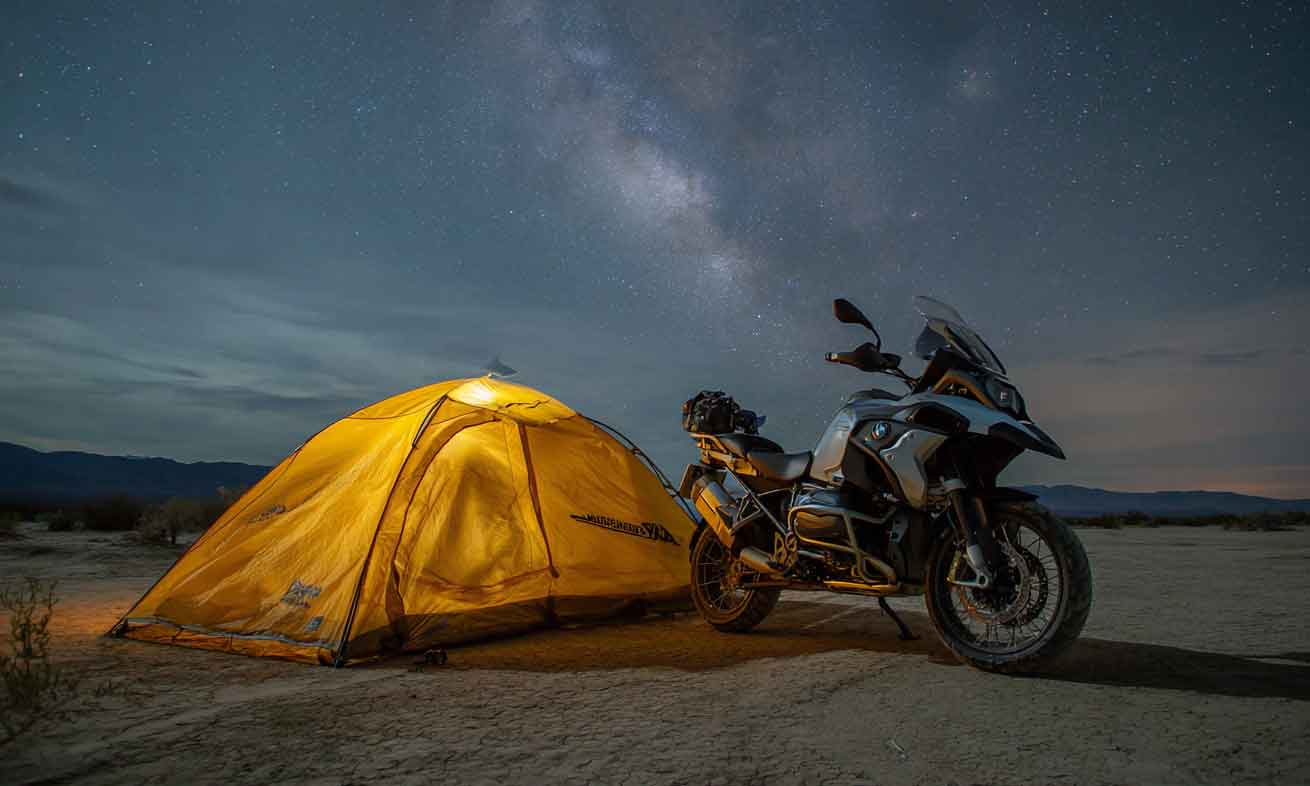
I spent years carrying everything I owned on my back. The Army has a saying for it. Ounces equal pounds, and pounds equal pain. You learn it the slow way, around mile eight, with a ruck packed by an optimist.
The same law governs a motorcycle. People think the bags change it. They don't. A loaded bike doesn't ache your shoulders. It just hides the weight somewhere else — in the fuel stops, in the wrestling match at the curb, in the camp chair you hauled a thousand miles and never unfolded. The cost is still there. You just pay it in a different currency.
So I pack a bike the way I packed a ruck. Subtract until it hurts, then ride.
Lay it all out. Take a quarter back inside.
Before a long ride I put every item on the garage floor. All of it. Then I look at the pile and remove a quarter of it before anything touches the bags. This is not a guess. Experienced tourers say the same number. Lay it out, cut 25 percent, then pack.
The cut is easy if you ask one question of each item. Is this mission-critical, or is it comfort I'm carrying out of fear. Fear packs heavy. A spare of a spare. The "just in case" jacket for weather the forecast already ruled out. Three books. It goes back on the shelf.
One more rule from the field. A thing that does one job has to fight for its spot. A thing that does three rides for free. A bandana is a dust mask, a sweat rag, a sling, and a neck wrap against the sun. Multi-use beats single-use every time there's a choice.
Clothing: wash one, wear one
This is where most people overpack by a factor of three. They bring a clean outfit for every day. That is hotel logic, not road logic.
On the road you carry two of the things that matter and wash on a cycle. Wear one. Wash one. The math holds whether the trip is four days or four weeks. What changes is laundry frequency, not bag size.
The fabric does the heavy lifting. Merino wool earns every dollar — it regulates temperature, it dries overnight, and it does not stink after three days, which matters when you are down to two of everything. Synthetics work too and cost less. Cotton does not. Cotton holds water, holds cold, and holds smell. Leave it home.
My multi-day kit, off the bike:
- Two base layers — merino. One on, one drying.
- Two pairs of socks, plus a third I treat as sacred and never get wet.
- Underwear — pack a few extra. They weigh nothing and you will be glad. This is the one place I don't ration.
- One pair of off-bike pants that aren't your riding gear. They double as sleep clothes.
- Flip-flops. Your feet have been in boots for ten hours. This is not a luxury. It's maintenance.
Hand-wash at night in the sink. Hang it. It's dry by the time coffee is. The discipline isn't a burden — it's the thing that lets the bag stay small.
Three layers. That's the system.
Weather on a bike isn't one thing. It's four things between breakfast and dinner. You don't beat that with a bigger coat. You beat it with a system that adjusts.
- Base. Merino against the skin. Wicks, warms, dries.
- Mid. A thin fleece or packable insulator. Goes on at altitude, comes off in the valley.
- Shell. A waterproof layer that fits over your riding gear, not under it. When the sky opens — and it will — you want to be sealed in under two minutes on the shoulder, not unpacking in it.
Three pieces cover forty degrees of swing. A closet does not fit on a motorcycle. A system does.
Tools: carry what you can use, not what you can buy
A tool you can't operate is just an ingot you're hauling for the manufacturer. I see riders with a forty-piece kit and no idea what half of it turns. That's not preparation. It's a costume.
Carry the short list, and know cold how to use every piece of it. The best way to learn which tools your bike actually needs is to do a service yourself before you leave. You'll find out fast which wrenches matter and which ones never come out of the roll.
What rides with me, every trip:
- The wrenches your bike takes. Not a universal set. The specific sizes that fit your machine. Check them against the bike, not against a catalog.
- Pliers and a multi-tool you trust.
- Zip ties, safety wire, and tape. Wrap a few feet of duct tape around a tool handle so it costs you no space. Zip ties have held a cracked fairing — and a flapping license plate — together long enough to get home.
- Spare fuses and a bulb. Ounces. They turn a dead night into a five-minute fix.
- A headlamp. Every roadside repair happens after dark. That's not bad luck. That's just how it goes.
One thing that doesn't ride with me: a tire repair kit. A flat is the failure people pack the most gear for, and I pack none. The plugs, the cartridges, the pump — that's weight I'd haul a thousand miles to maybe use once. If I do go down on a flat, the fix is already in my pocket. A phone and a card. Sometimes that's a buddy running to the nearest Walmart or auto parts store for a plug kit and meeting me on the shoulder. Sometimes it's a flatbed to whichever of those is closest. Either way the repair is twenty dollars and an hour, not a thousand miles of dead weight. I'll take the hour over the kit every time.
Improvise the rest. Half of fixing a thing in the field is being willing to get creative with what's in the bag. The kit gets you to the next town. The town has the parts store.
Place the weight low and forward
Here I'll temper my own sermon. A real minimalist kit lands around thirty pounds. On most bikes you will barely feel that. A heavy cruiser or a loaded tourer swallows it without comment. I'm not going to tell you thirty well-placed pounds turns a good-handling bike into a bad one. It doesn't.
Placement still earns its keep, and it costs you nothing to get right. Heavy items low and forward, close to the machine's center of gravity — tools and water down low. Light, bulky things — the sleeping bag, the clothes — up and back. It's the ruck rule flipped: in the field we packed heavy high and against the spine; on a bike you want it low.
How much it matters depends on the bike. A big machine won't notice the load either way. A light one — or a kit slung high and far to the rear — will mention it in the first set of corners. So put the weight where it belongs and don't lose sleep over the rest. At minimalist weight, the part that counts is already handled.
The point isn't less. It's ready.
Minimalism gets sold as deprivation. It isn't. A light load drinks a little less fuel, loads and unloads in one trip, and never fights you at the curb. On the days you're tired — which is when mistakes get made — there's simply less bike to manage. And you spend your nights riding or resting instead of sorting a pile of gear you were never going to touch.
Carry what the trip requires and nothing it doesn't. Then the road is the only thing left to deal with. That's the whole point of going.
Plan the route, space the stops, pick the beds. Pack the short list. Ride.