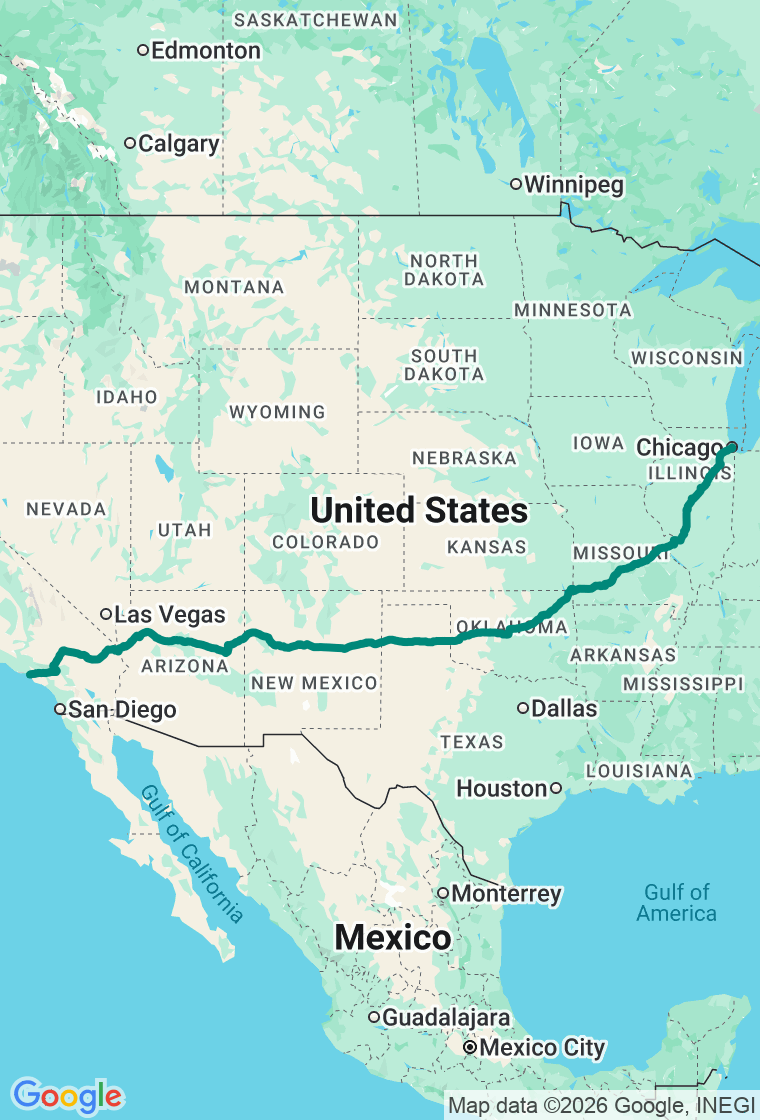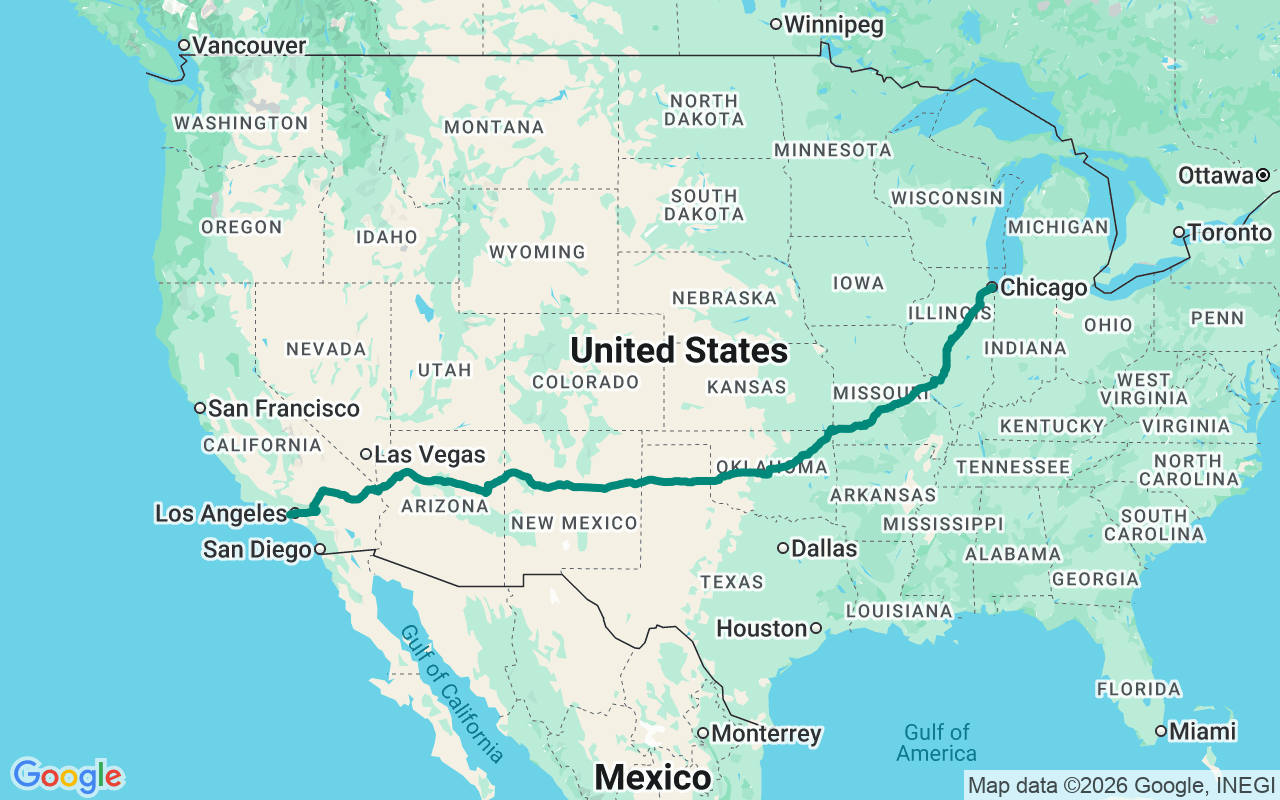
Westbound — the historically correct direction, chasing the sunset
The Whole Mother Road
Twenty-four hundred miles, eight states, and a hundred years of American road. There is one Mother Road, and this is the whole of it.
Route 66 was commissioned in 1926 — it turns a hundred in 2026 — and for decades it was the Main Street of America: the road Steinbeck called the Mother Road, the path the Dust Bowl took west and the post-war family took on vacation. The interstates bypassed it and it was decommissioned in 1985, but it never really died. It survives as a patchwork of "Historic Route 66" alignments threaded between the freeways, lined with neon motels, fiberglass giants, ghost towns, and the best roadside diners in the country. Eleven days, Chicago to the Santa Monica Pier. Drive it in spring or fall — the desert Southwest is brutal in summer, the Midwest brutal in winter — and follow the Historic 66 signs, because it's not one road but many.
Illinois & Missouri. Start where the road starts: breakfast at Lou Mitchell's in Chicago, open since 1923, then the Begin sign on Adams Street. South past the Gemini Giant (the space-age fiberglass astronaut, restored and re-homed in Wilmington in 2024) and the corn dogs at Springfield's Cozy Dog, over the bent Chain of Rocks Bridge into St. Louis for a Ted Drewes "concrete" so thick they hand it to you upside down. On through the Missouri Ozarks — Cuba's murals, the world's second-largest rocking chair, the neon of the Munger Moss.
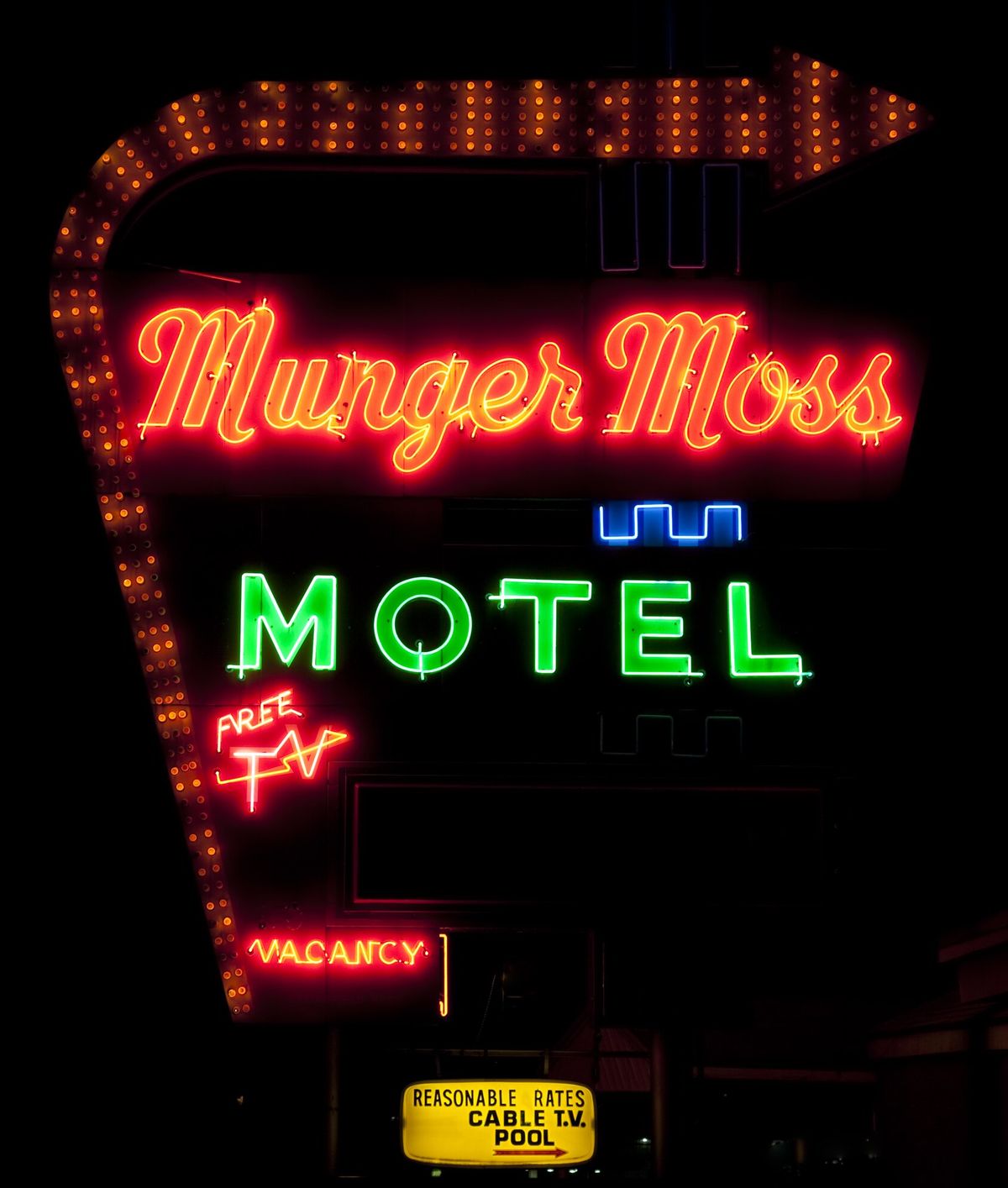
About that neon. The Munger Moss Motel in Lebanon went up in 1946, and Bob and Ramona Lehman ran it for more than fifty years — half a century of travelers checking in under that sign. It isn't a motel in the old sense anymore: the property was sold, the rooms are becoming apartments, and the handful promised back for overnight guests have no opening date yet. The sign is the part that was saved. The new owner gave it to the City of Lebanon in 2025, the city restored it, and in June 2026 it was switched back on — yellow script, green MOTEL, an arrow of chasing bulbs. It's lit every night from 8 p.m. to midnight. So this one is a photograph now, not a bed: pull in, take the picture, and sleep down the road in Springfield. In daylight it's still the handsomest sign in Missouri; to see it glowing, be in Lebanon after eight.
Kansas, Oklahoma & Texas. Thirteen quick miles of Kansas, then Oklahoma's run of folk-art landmarks — the walk-in Blue Whale of Catoosa, the 1898 Arcadia Round Barn, the sixty-six-foot soda bottle at Pops — and steak in Tulsa and Oklahoma City. Into the Texas Panhandle for the two definitive 66 stops: the Big Texan in Amarillo, home of the free seventy-two-ounce steak if you can finish the whole meal in an hour, and Cadillac Ranch, ten Caddies buried nose-down in a wheat field since 1974, yours to spray-paint.
New Mexico & Arizona. The neon of Tucumcari's Blue Swallow Motel, the swimming hole at Santa Rosa's Blue Hole, green chile in Albuquerque. Across into Arizona for the concrete teepees of the Wigwam Motel, the corner in Winslow the Eagles made famous, Meteor Crater (nearly a mile across, fifty thousand years old), and a detour to the South Rim of the Grand Canyon. Then the purest surviving stretch of the road: Seligman, where the whole Historic 66 revival began, the Hackberry General Store, and the white-knuckle switchbacks of Sitgreaves Pass down to Oatman, where wild burros work the street.
California. The last act crosses the Mojave — Roy's lonely neon at Amboy, the Bagdad Cafe, a second Wigwam Motel at Rialto — and finally drops to the sea at the Santa Monica Pier and the "End of the Trail" sign. (The road never officially ended at the pier; the sign went up in 2009. Nobody minds. It's the right place to stop.)
And hold the plan loosely — Route 66 is the patron saint of the detour. The plan's a backbone, not a cage: the neon motel that still has its sign lit, the diner with one item worth driving for, the ghost-town gas station, the giant fiberglass cowboy nobody else slows down for. This road is nothing BUT the stuff that isn't on the interstate — that's the whole point of taking it. Follow the old alignment when the freeway's faster, talk to the person behind the counter, and let a hand-painted sign reroute your afternoon. The best stop is the one that wasn't on the list. Go find it.