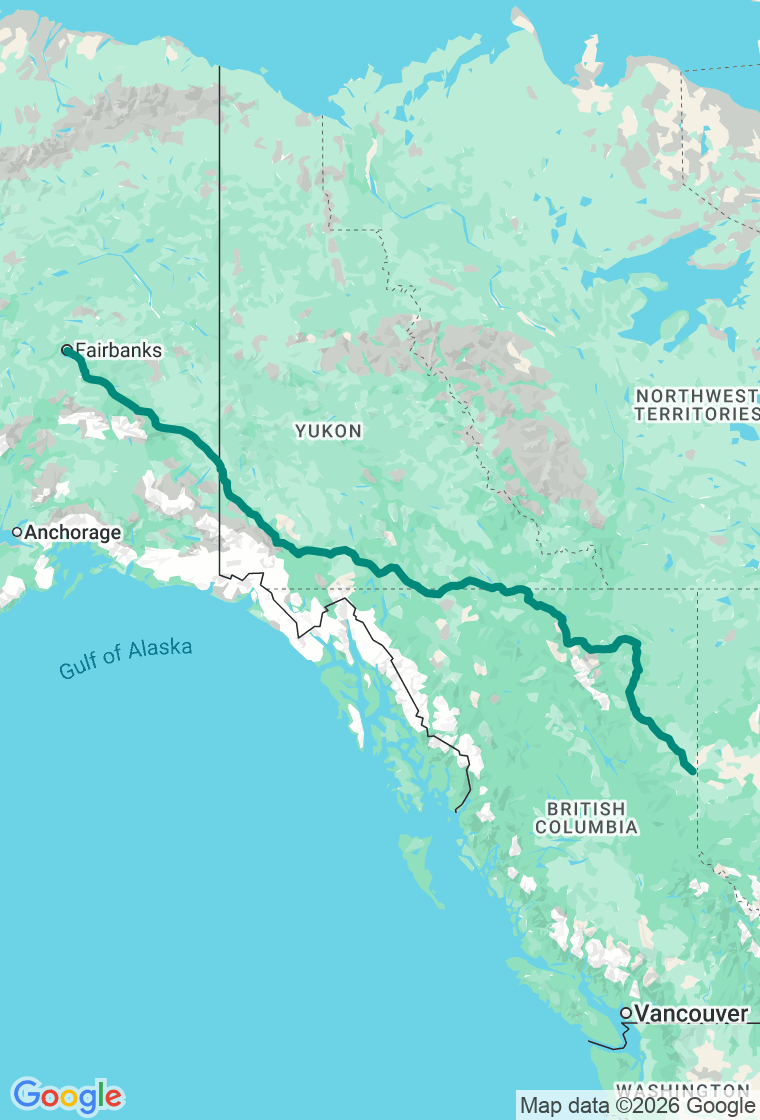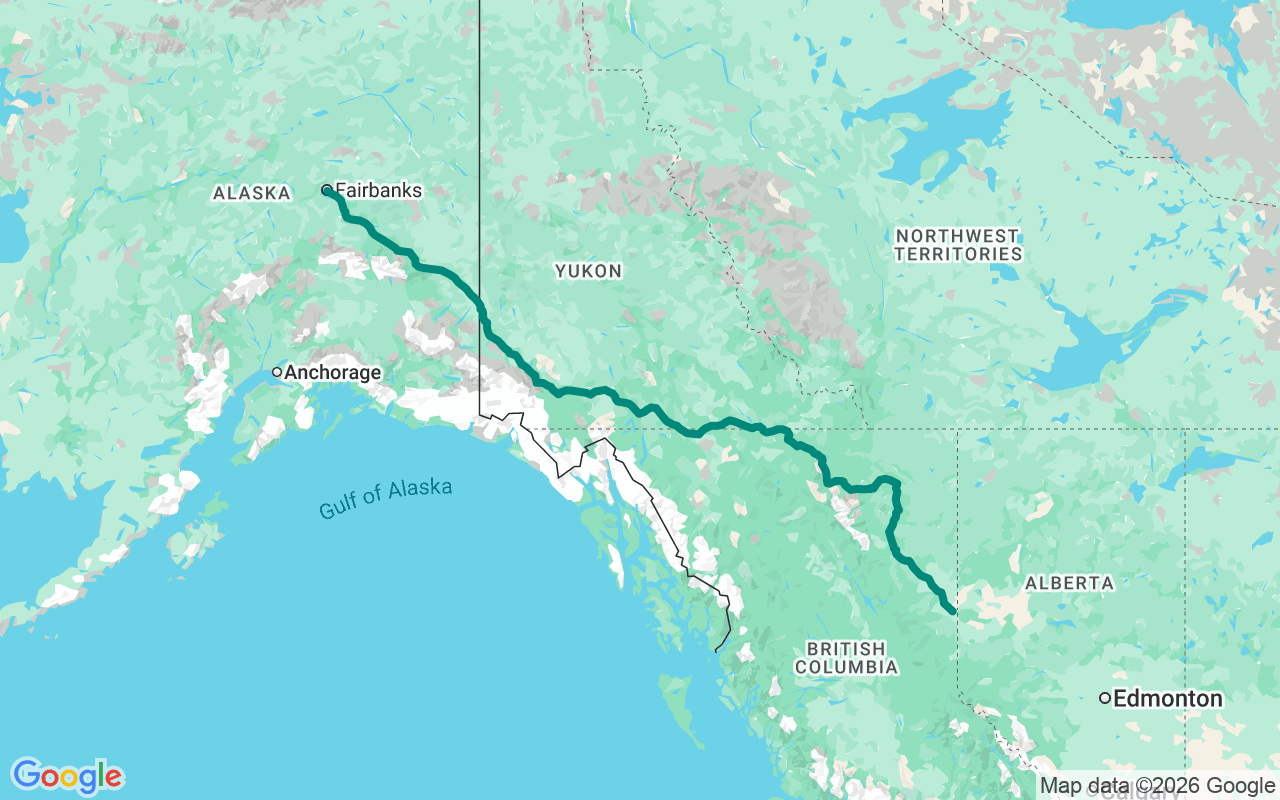
Northbound — the only direction that makes sense. You ride toward Alaska.
The Road the Army Built
Fourteen hundred miles of wilderness road to Alaska, built by the Army in a single wartime summer — moose in the hot springs, bison on the shoulder, and the midnight sun the whole way.
The Alaska Highway — the ALCAN — runs from Mile 0 at Dawson Creek, British Columbia, across the Yukon to interior Alaska. The US Army built it in about eight months in 1942, a wartime supply road carved out of the subarctic wilderness after Pearl Harbor by more than ten thousand soldiers — a third of them Black troops in segregated regiments whose work here helped push the Army to desegregate in 1948. It's paved now, but it's still wild and remote: boreal forest and northern Rockies, wood bison and bears and stone sheep on the road, fuel hundreds of miles apart, and in summer a sun that barely sets. Drive it June to August, carry supplies, keep a copy of The Milepost on the seat, and fill the tank at every chance.
Day 1. A diner breakfast and the Mile 0 Post photo in Dawson Creek, then north to Fort Nelson through the first big empty.
Day 2. The highlight of the lower road: Liard River Hot Springs, the second-largest natural hot springs in Canada, a steaming boreal oasis where moose wade in the warm marsh. Then Watson Lake and the Sign Post Forest, where a homesick GI nailed up a sign to his Illinois hometown in 1942 and travelers have been adding their own ever since — there are something like a hundred thousand of them now.
Day 3. Into the Yukon — the Teslin Tlingit Heritage Centre and its carved clan poles, the basalt gorge of Miles Canyon, and the territorial capital of Whitehorse for ribs and salmon. Both ends of that day keep summer hours: the heritage centre opens roughly June through August, and Klondike Rib & Salmon runs from Mother's Day weekend to late September. Outside those months the five clan poles still stand at the centre's entrance, and Whitehorse has other kitchens.
Day 4. West past Haines Junction and Kluane National Park, which guards Mount Logan — at nearly twenty thousand feet the highest peak in Canada — and the largest non-polar icefields on earth. On to the tiny border town of Beaver Creek.
Day 5. Cross into Alaska, a burger at Fast Eddy's in Tok, and the official end of the ALCAN at Delta Junction, where the monument reads Mile 1422. Most travelers keep going the last hundred miles to Fairbanks — and so do you, for crepes and a night at the Grizzly Lodge.
And hold the plan loosely — up here the road sets the terms and the wildlife sets the schedule. The plan's a backbone, not a cage: the pullout where a grizzly's grazing the ditch, the hot spring with steam rising into the cold, the gravel side road to a lake nobody's named, the diner that's the only light for a hundred miles. This drive rewards patience and a full tank far more than a tight itinerary. Just fuel up every time you can, slow down for the frost heaves and the stone sheep, and let the midnight sun stretch the day as long as it wants. The best stop is the one that wasn't on the list. Go find it.