

The short version
- Free camping is on national forest and BLM land. Dispersed camping is legal by default there, usually 14 days, at no charge. National parks: campground or backcountry permit only.
- Dogs hike on forest and BLM trails. In national parks they stay on roads, in campgrounds and on paved paths; most big parks keep them off trails.
- Drones are banned in every national park and every wilderness area. They are fine over most national forest and BLM land, away from wildfires.
- The $80 pass covers entry, not camping. It pays off at 3 fee parks a year and is no good at state parks or tribal parks.
- Tribal land is a sovereign nation, not public land. Permits come from that nation's parks department; the federal pass means nothing there.
- The sign tells you the rulebook. Brown arrowhead: Park Service. Green shield: Forest Service. Triangle: BLM. Blue goose: wildlife refuge.
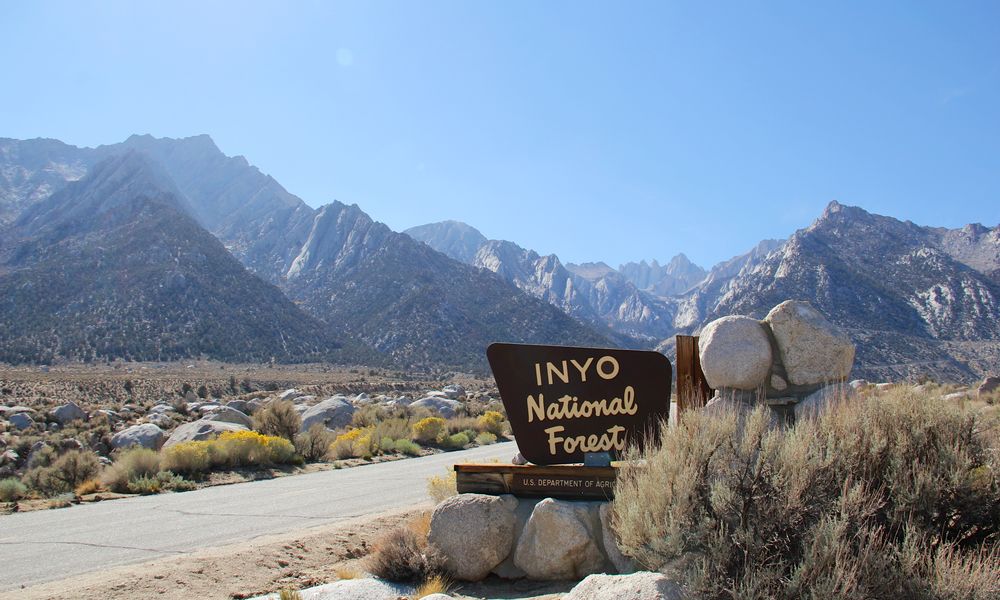
The pull-off was flat dirt with a fire ring somebody else had built, a quarter mile up a forest road, and it cost nothing. The next morning I drove 200 yards further, crossed a boundary sign, and stood on ground where the same night runs $30 and books out months ahead.
Same dirt, same pines, same mountain. What changed was the name on the sign, and with it the whole rulebook: where you can sleep, whether the dog gets out of the truck, whether you can light a fire, whether the drone stays in the bag. Public land is 9 different things that happen to be green on one map.
One fact explains more than it should: the Forest Service lives in the Department of Agriculture, not Interior, because in 1905 the government thought of forests as a crop. That filing decision is why 2 signs 200 yards apart disagree about your dog.
Can I camp, bring the dog, light a fire or fly a drone here?
Find the land down the left, find what you want to do across the top.
Two words do quiet work. Usually means yes by default, with local bans stacked on top: fire season, a closure, a posted order. Varies means the unit or the state decides, and the note says which.
What are the rules in national parks and Park Service monuments?
Campground or backcountry permit only, no drones, the dog off most trails, and about $35 per vehicle for 7 days at the big parks.
Interior, 1916, and a charter that puts preservation first and your convenience second.
Start with the designation trap. National monument says how a place was created, not who runs it: a president proclaims one under the Antiquities Act, and somebody else has to manage it. The Park Service manages some; the Forest Service and the BLM manage others under looser rules. So 2 national monuments can disagree completely about whether you may sleep on the ground.
The rules that bite inside a Park Service unit: no pull-off-and-sleep, since backcountry camping needs a permit. Drones have been banned in every unit since a 2014 policy memo. The dog is welcome on roads, in campgrounds and on paved paths on a 6-foot leash, but trails depend on the park, and the big western parks mostly say no. Fires go in the ring provided. Just over 100 of the more than 400 units charge anything at all, mostly per vehicle, topping out at $35 for 7 days. Since January 2026 there is a second line on the receipt at 11 famous parks, a $100 nonresident fee per person 16 and older, covered in what changed in the parks this year.
For your trip: book the campground the morning the reservation window opens, or sleep outside the boundary on Forest Service land, often the next sign over.
Can you camp for free in a national forest?
Yes. Dispersed camping is legal by default in a national forest, usually 14 days at no charge, on a road the Motor Vehicle Use Map shows and away from developed sites.
Agriculture, 1905, and Gifford Pinchot, whose standard was the greatest good for the greatest number in the long run. A national forest is managed for multiple use: logging, grazing, mining, wildlife and you, all at once, which is why a forest road can deliver you to an alpine lake and a clear-cut in the same hour.
For a traveler this is the best deal in the country. The stay limit is set per forest. Keep the site at least 150 feet from any stream, and away from the developed stuff, because camping in the vicinity of a campground, picnic area or trailhead is out.
The map that governs the driving is the Motor Vehicle Use Map, a product of the 2005 Travel Management Rule, and it is blunt: a route not shown on the MVUM is not open to public motor vehicle travel. Dogs are fine, off leash across most of the forest and leashed in developed areas. Drones are fine over most of a forest, never in wilderness and never near a wildfire. Fires are the variable: some forests want a free campfire permit, California wants one year-round even for a gas stove outside a developed area, and any of it can be suspended overnight.
Read the forest's alerts page before you commit to a night, and download the MVUM while you still have bars.
Can you camp anywhere on BLM land, and for how long?
Yes, almost anywhere that is not posted closed, for free: 14 days in any 28-day period, then you move on, often at least 25 to 30 miles.
Interior, 1946, and the strangest origin story of the bunch. The BLM manages 245 million acres, 1 in every 10 acres in the country, and it is the land that was left after everyone else took theirs: the public domain nobody homesteaded and nobody made a park out of. That is why it is mostly Great Basin sagebrush and desert Southwest, and why you have no postcard version of it in your head.
It is the loosest ground in the system, and the BLM's own camping page is short enough to read at the trailhead. Vehicles stay on designated roads and trails unless an area is signed open for off-road use. Drones are fine outside wilderness and away from wildfires, though the BLM counts a launch as vehicle use, so you launch and land on a designated route. More than 99 percent of BLM land is open to hunting and fishing with the state license.
Snowbirds get their own arrangement: the Long-Term Visitor Areas in California and Arizona sell a $180 permit good from September 15 to April 15, or $40 for 14 days, which is how Quartzsite happens every winter.
The BLM runs its own national monuments under its own rules, and those rules move with the politics, as the last few years at Bears Ears and Grand Staircase made clear. Plan around it: this is where the $0 nights live, and where the road turns to sand without telling you.
Can you camp, hike or hunt in a national wildlife refuge?
Hike, yes. Hunt and fish in season, yes on many refuges. Camp, rarely, and only where a refuge provides a site. Drones are prohibited.
Fish and Wildlife Service, Interior, and the oldest idea here: Pelican Island became the first national wildlife refuge in 1903, set aside by executive order to protect the birds nesting on it. There are more than 570 refuges now and the mission has not moved. A refuge exists for the wildlife; you are a guest.
Fires are out except where a refuge provides for one, and drones are prohibited by federal regulation. Dogs depend on the refuge, from leashed to stay-in-the-vehicle to no. Plenty of refuges are open daylight hours only.
The flip side is that hunting and fishing are welcome in season, in the zones a refuge opens, under state licensing. About 30 refuges charge a small entrance fee and the rest are free, and a current Federal Duck Stamp gets you into any that charge. Drive an auto-tour loop at dawn; it beats most park overlooks and there is nobody on it.
Can you camp at Army Corps of Engineers lakes?
Yes. Corps of Engineers lakes have designated campgrounds booked on recreation.gov, with a limit of 14 days in any 30, and they are some of the cheapest lakeside sites in the country.
Why does a branch of the Army run campgrounds? Because the flood-control dams it built came with shorelines attached, and the 1944 Flood Control Act let it develop them for recreation. The result is more than 400 lakes across 43 states with campgrounds nobody talks about: on recreation.gov, cheap, lakeside, often with hookups, and rarely full outside holiday weekends.
Corps rules are specific. Camping only at designated sites, 14 days in any 30 without written permission. Fires only where the district marks. Pets leashed in developed areas and never on the swimming beach. Drones fall under the Corps regulation covering aircraft, so it comes down to what the local district designates. The $80 interagency pass covers Corps day use and not camping; the Senior and Access passes take 50 percent off camping too. The Corps also sells its own $40 annual day-use pass, good at Corps sites and nowhere else.
Reclamation reservoirs are a different animal. Lake Powell, Lake Mead and Shasta are mostly run by somebody else on Reclamation's behalf, so the rulebook changes at the boundary even though the water does not. When the park is full, search recreation.gov for Corps of Engineers.
What is not allowed in a designated wilderness area?
No motor vehicles, no motorized equipment, no bicycles, no drones and no structures. Camping on foot is the point, and whether the dog can come depends on which agency manages that wilderness.
The Wilderness Act was signed on September 3, 1964, and created no agency. It draws a line on top of land the Park Service, the Forest Service, the BLM or Fish and Wildlife already manage, and inside it the rules get stricter.
Section 4(c) is the part to know by heart: no temporary road, no use of motor vehicles, motorized equipment or motorboats, no landing of aircraft, no other form of mechanical transport, no structure or installation. Mechanical transport is why bicycles are out, which surprises a rider every summer, and why trail crews in there still swing crosscut saws. Drones are out on both counts.
Backcountry camping is the entire point, though the popular areas ration it with permits, and group size is capped area by area. Fires are banned in many areas outright or above a set elevation. Dogs are welcome in Forest Service and BLM wilderness on a leash or under voice control; most Park Service and Fish and Wildlife wilderness says no. There are no campgrounds inside, by definition; the one at the trailhead is outside the line, and that sign is where the bike stays behind.
How do you tell whose land you are on from the sign?
By its shape and color: a brown arrowhead is the Park Service, a green shield is the Forest Service, a triangle is the BLM, a blue goose is a wildlife refuge, a castle is the Corps of Engineers.
Signs fade, fall over and get shot at. When one is missing, a land-ownership app is a guess; the field office phone is an answer.
How do state park, state forest and trust land rules differ?
Every state writes its own rules: entry is per vehicle, per person or on your license plate, dogs are leashed and barred from some trails and beaches, and the $80 federal pass is no good anywhere.
There are 50 rulebooks here. What is worth learning is the shape of the variation: see it once and you can guess right in a new state, then check.
Entry fees come in 3 shapes. Per vehicle, the California model: $10 a car, $20 on a peak summer weekend, and Florida charges by the vehicle too. Per person: $8 a head at Palo Duro Canyon in Texas, $4 for adults in New Hampshire. On the license plate, the civilized version: Colorado attaches a $29 Keep Colorado Wild Pass at DMV registration, Michigan adds $15 at renewal. Annual passes run the same spread, $15 in Michigan to $195 in California.
Dogs are usually welcome on a leash and usually barred from somewhere specific: California wants a 6-foot leash and keeps dogs off trails and beaches. Camping books through that state's own system. State forests are the looser cousin, and in some states free: Michigan allows dispersed camping on state forest land more than a mile from a state forest campground, at no charge, with a registration card posted at the site. State wildlife areas want a hunting or fishing license, or a $43.87 pass in Colorado, even if you only want to walk.
Then there is state trust land, which is not public land at all. It is granted acreage the state manages to raise money for schools, and Arizona and New Mexico both require their own recreation permit to set foot on it, $35 a year in New Mexico. The $80 federal pass buys nothing at any of these gates. Read the state's own parks site, not a third-party listing.
Can you camp or take photos on tribal land?
Only with that nation's permission. Tribal land is a sovereign nation, not public land: camping needs its parks department's permit, photographing people needs their consent, and drones are banned at Navajo tribal parks.
A reservation is not a kind of park, and being a pale color on your road atlas does not make it public. The federal pass means nothing there.
The Navajo Nation is the example most road trippers meet first, so take what follows as its rules and nobody else's. Navajo Tribal Parks charge per person: Monument Valley is $10 a person per day, plus $15 a vehicle for the scenic drive, and camping runs $15 per person per night. Hiking or camping away from the developed areas requires a backcountry permit. Drones are prohibited at every Navajo Tribal Park and will be confiscated. Fires go in a grill, never on open ground. Pets are not allowed, and off-road vehicles are prohibited outright. Commercial photography needs a permit, and the rules ask plainly that you get permission before photographing Navajo people.
Nothing about those prices predicts the next nation's: the Havasupai Tribe sells campground permits at $455 a person for 3 nights, on its own calendar. Get the permit from that nation's parks website before the trip, not at a gate you hope is staffed. And know which color you are standing on: that famous view of the buttes is Navajo land, not a national park.
Can you camp on county land or private land?
County parks often run cheap campgrounds, city parks almost never do, and private land is off limits without the owner's permission, whether or not it is fenced or posted.
County systems are good at camping. San Diego County, my home county, runs tent sites at $33 and charges $5 to park at some locations. Fires go in a provided ring between 7 a.m. and 11 p.m., and are banned outright on a red flag day. Dogs need a 6-foot leash on the trails, and the site fee covers 2 of them, with $2 a night for a third. Drones need written permission outside a designated area. City parks run on ordinance, which is where overnight parking rules and drone bans live.
Private land is the default, not the exception. Colorado's wildlife agency says it as clearly as anyone: private lands do not need to be posted or fenced. A gate across a two-track means turn around. When the map is blank, assume somebody owns it.
Is the $80 America the Beautiful pass worth it?
Yes if you will pay entry at 3 or more national parks this year. $80 buys a year of entry to every park and federal day-use site, but not camping, state parks or tribal parks.
It is arithmetic, not faith.
At a gate that charges per vehicle, everyone in the car rides in on your pass; at a gate that charges per head, it covers you plus 3 adults, and anyone under 16 was free anyway. Plenty of people never pay the $80 at all. Seniors pay $20 a year or $80 once for life, and those carry a 50 percent camping discount the standard pass does not. The Access pass is free, and so is the military pass, veterans and Gold Star families included. Every 4th grader gets a free year. And since January 2026 there is a $250 nonresident annual pass.
How do you check the rules before you go?
Check 3 things the morning you leave: the unit's own alerts page, the ranger district or field office phone, and the forest's Motor Vehicle Use Map or the BLM field office map.
Everything above is the default; the check on the ground governs your night. The alerts page gets fire restrictions and closures first, the field office answers the phone and knows what the gate looks like today, and the maps are worth downloading while you still have signal.
Then do the part that is fun. The Destinations map draws the boundaries of parks and the monuments the Park Service runs, so you can see which sign you are about to cross before you are standing at it. And the planner ends each day in a town, which turns the campground question into one you answer on purpose instead of at dusk with 40 miles of sand behind you.