
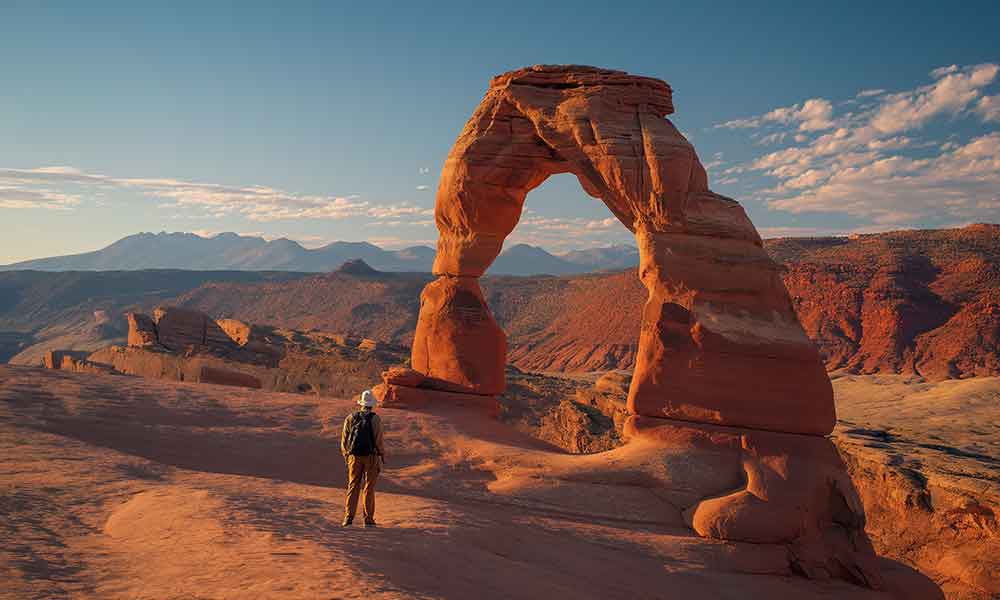
The short version
- Arches, Yosemite, Glacier, and Mount Rainier dropped timed-entry reservations for 2026. You no longer need one to drive in.
- Glacier is the asterisk. It dropped vehicle reservations and simultaneously added a three-hour parking limit at Logan Pass plus a ticketed, reservation-only shuttle. For a lot of hikers that was stricter, not looser. Both ran July 1 to September 7 and have now ended for the season; Logan Pass parking is first-come with no time limit until the alpine road closes for winter.
- Only one park still has a true park-wide entry reservation: Rocky Mountain. The others you have read about are one road, one cave, or one parking lot.
- Fees changed a great deal, and unequally. A new $250 annual pass for non-U.S. residents, plus a $100-per-person surcharge at eleven headline parks. U.S. resident pricing is unchanged at $80.
- Crater Lake did not close. Several major outlets reported that it would. The real closure is one trail and the boat tours, for three seasons.
- Grand Canyon has no overnight lodging on either rim until at least October. A flash flood on August 29 tore through the bottom of the canyon, killed two hikers, closed Phantom Ranch and the inner-canyon trails indefinitely, and knocked out the pipeline that supplies the South Rim’s water. Every South Rim hotel and lodge has been closed since August 31; the concessioner now says through September 30, with October 1 arrivals proceeding for now. The park is open for the day. Sleep in Tusayan or Williams.
- Mount Rainier’s Sunrise closure is a month old and still has no end date. White River Road and its campground reopened September 5, and Sunrise Road is open to walkers and cyclists — but it is still closed to vehicles, and the park’s September 11 update changed nothing. The fire that started it is out; a second complex beside it is not. The rest of the park is open. This is the kind of thing no fee or reservation story tells you.
- Olympic is now cut in half at night, and will be by day from the 24th. The only highway across the west side of the park, US 101 at the Hoh River bridge, is closed overnight every night from September 14 to 22 and then closes fully for three multi-day stretches between September 24 and October 13. There is no detour; going round the peninsula adds four hours.
- National Park Week is over. It ran August 22 to 30 with a fee-free day on the 25th. The next fee-free day is this Thursday, September 17 — Constitution Day — and, like all of them now, it is for U.S. residents only.
Reservations: four parks let them go
The National Park Service announced on February 18, 2026 that Arches, Yosemite, and Glacier would not require timed-entry reservations this season. Mount Rainier made the same call in its own announcement a week later, on February 25 — which is why it is missing from a lot of the coverage, and why that first release does not name it. Each park says it plainly:
- Arches: “In 2026, advanced timed-entry reservations will not be required at Arches.”
- Yosemite: “A reservation is not required to enter Yosemite in 2026.”
- Glacier: “Vehicle reservations will not be required anywhere in the park in 2026.”
- Mount Rainier: “Mount Rainier National Park will not implement a timed entry reservation for any portion of the park in 2026.”
Two things worth getting right, because most coverage does not. First, these are one-year decisions. No park has said the programs are permanently abolished, though at least one outlet ran a headline saying otherwise. Second, and more important if you are planning a hike:
Glacier did not simply deregulate
In the same breath that it dropped vehicle reservations, Glacier added two new controls at Logan Pass, the busiest destination on Going-to-the-Sun Road:
- A three-hour parking limit at Logan Pass from July 1 through Labor Day, September 7, 2026 — enforced 24 hours a day. It ended on schedule; the park confirmed on September 8 that parking is back to first-come, first-served with no time limit for the rest of the season — which, for the alpine section of the road, typically means around the third Monday of October, or earlier if it snows. Going-to-the-Sun Road was fully open on September 14.
- A reservation-only shuttle to Logan Pass at $1 per person through Recreation.gov — that is the booking fee rather than a fare, and tickets are needed for everyone over age 2. The shuttle runs July 1 to September 7. The previous free hiker and biker shuttle was eliminated.
If you wanted to hike the Highline Trail this summer — or do anything from Logan Pass that took longer than three hours — you needed a booked shuttle ticket. That is a reservation requirement wearing a different hat, and it was the only genuinely new restriction we found anywhere in the system this year. Whether it comes back in 2027 will be decided over the winter. “Glacier drops reservations,” on its own, is a misleading sentence.
What still needs a reservation — and what people get wrong
This is where most round-ups go sideways. They print a list of parks “still requiring reservations” without saying what is actually being reserved. Of the commonly cited parks, only Rocky Mountain requires a reservation to enter the park at all.
- Rocky Mountain — a genuine park-wide timed entry. Two tiers, roughly 9 a.m. to 2 p.m. through October 12, or 5 a.m. to 6 p.m. through October 18 if it includes Bear Lake Road. Outside those hours you need nothing — the workaround nobody mentions.
- Acadia — the Cadillac Summit Road only. Not the Park Loop Road, not Ocean Drive, and not if you hike or bike up.
- Haleakalā — the summit between 3 and 7 a.m. only, for sunrise. Any other hour, no.
- Carlsbad Caverns — the cave, not the park, and a timed-entry ticket rather than a reservation in the Rocky Mountain sense. Ranger-guided tours here have been thinned by staffing rather than cancelled: as of September 14 the schedule still lists King’s Palace at 10:30 a.m. and 1:30 p.m. Thursday through Tuesday — walk-up tickets only, and only if the park has the staff that day — and Lower Cave at 9:30 a.m. on Wednesdays. Call the visitor center the morning of rather than assuming either will run.
- Muir Woods — the parking lot, booked on its own site rather than Recreation.gov. Walk or bike in and there is no cap.
- Great Smoky Mountains — not a reservation at all. It is a parking tag, $5 a day, required for any vehicle parked more than 15 minutes. The park itself notes it “does not guarantee you a parking spot.”
Trail permits are a separate category again: Angels Landing at Zion, Half Dome at Yosemite, Old Rag at Shenandoah. Those never went away and none of this affects them.
So are the parks more crowded? Here are the numbers.
This is the part of the story that has produced the most heat and the least data. Rather than quote people arguing about it, we pulled the National Park Service’s own monthly visitation counts. Here is 2026 against the same months last year.
| Park | 2026 policy | Visits vs. 2025 |
|---|---|---|
| Mount Rainier (Jan–May) | Dropped reservations | +15.0% |
| Yosemite (Jan–Jun) | Dropped reservations | +10.0% |
| Arches (Jan–Jun) | Dropped reservations | +7.8% |
| Glacier (Jan–May) | Dropped reservations | −2.0% |
| Rocky Mountain (Jan–May) | Kept timed entry | +4.7% |
| Zion (Jan–Jun) | No change either year | +0.9% |
Three of the four parks that dropped reservations are up more than the two comparison parks. That is a real pattern and it is fair to notice it.
And then there is Glacier, which is down two percent. If dropping reservations reliably produced a surge, Glacier ought to be the clearest case — it removed the most restrictive system of the four. It went the other way. There is a mundane explanation available: Going-to-the-Sun Road did not open fully until June 22 this year, six days later than in 2025, and that road is most of the reason people come.
Which is the honest summary. Visitation is up at most of the parks that deregulated, and we cannot tell you the deregulation caused it. 2026 is a busy year across the system generally. The parks that dropped reservations are also, not coincidentally, the parks that were busy enough to need them in the first place. Anyone telling you these numbers prove the policy worked, or prove it failed, is adding something the numbers do not contain.
Two caveats on the data itself. The 2026 figures are preliminary until early 2027. And the table is a snapshot of what the Park Service had published when we last pulled it in early August — at that point Glacier, Mount Rainier and Rocky Mountain had not reported June, so those three are five-month comparisons rather than six. That is worth holding onto, because Rocky Mountain is one of the two parks the comparison leans on. Later months have likely posted since; we would rather leave a dated snapshot standing than quietly refresh some rows and not others.
What the parks themselves are saying
Official park advisories are more useful than anyone’s opinion, and they are refreshingly blunt. Arches currently warns on its own conditions page:
“Between March and October, wait times at the park entrance may exceed 60 minutes… On very busy days, when the entrance line backs up to the highway or when parking lots fill to capacity, we may have to temporarily delay additional entries.”
Yosemite tells visitors to arrive before 8 a.m., after which Valley parking is usually full, and warns that if you find a space you should plan to keep it — you will not find another.
Worth noting in the other direction, because it cuts against the loudest version of this story: when we checked on July 19, Yosemite’s live conditions page carried no congestion, entrance-delay, or parking-capacity alert at all. Its posted alerts were roadwork, bears, and river safety. Mount Rainier’s carried no congestion advisory either. Whatever is happening at those two parks, they were not flagging it as an emergency. That is a live page and this is a snapshot of it — check it yourself before you drive.
And here is why that instruction is not boilerplate. On August 17, and again on August 23, Mount Rainier’s alerts page still carried no congestion advisory — it led with a wildfire closure instead.
The practical part: how not to sit in the line
Every one of these parks publishes the same basic advice, and it works whether or not there is a reservation system:
- Go early or go late. Mount Rainier says before 7 a.m. or after 4 p.m. Yosemite says before 8 a.m. Arches runs a webcam so you can look at the entrance line before you commit to it.
- Go midweek. Yosemite says so outright.
- At Rocky Mountain, drive around the window — but check which window. For most of the park timed entry runs 9 a.m. to 2 p.m., so arriving before or after needs no permit. Bear Lake Road is the exception, and it is the part most people are going to: that corridor is 5 a.m. to 6 p.m. Turning up at 7 a.m. beats the general window and still leaves you needing a Bear Lake permit.
- Do not circle the lot. Arches explicitly asks people not to wait in roadways for parking spaces — that behavior is a large part of what turns a full lot into a backed-up road.
Fees: the biggest change of the year
Under an executive order signed in July 2025, park pricing split into two tiers on January 1, 2026.
- U.S. residents: the America the Beautiful annual pass is still $80. Senior, Military, Access, 4th Grade, and Volunteer passes are all unchanged. One genuine improvement: passes now cover two motorcycles instead of one.
- Non-U.S. residents: a new $250 annual pass, and a $100-per-person surcharge for anyone aged 16 or older at eleven parks — Acadia, Bryce Canyon, Everglades, Glacier, Grand Canyon, Grand Teton, Rocky Mountain, Sequoia & Kings Canyon, Yellowstone, Yosemite, and Zion. The Park Service sets all of this out on its nonresident fees page.
The surcharge stacks on top of the normal entrance fee rather than replacing it, and it is per person, not per vehicle. But do the arithmetic before you pay it at the gate: the surcharge only applies from age 16, and the $250 non-resident pass covers the holder plus three additional adults in the same party. So four adults from abroad visiting Yellowstone face $400 in surcharges paid individually — or $250 for the one pass, which also covers every other park on the list for the year. Two adults with younger children may well be better off paying per person. The surcharge has been in effect continuously since January 1 and is being collected now.
The 2026 fee-free days are February 16, May 25, June 14, July 3–5, August 25, September 17, October 27, and November 11 — but note they now apply to U.S. residents only.
One scheduling quirk has now played out: National Park Week moved to August 22–30 this year, out of its usual April slot, to line up the Park Service’s 110th birthday with the country’s 250th, and Tuesday, August 25 — the birthday itself — was the fee-free day inside it. A fee-free day dropped into the middle of a promoted week, in late August, at parks that mostly no longer meter arrivals, was the busiest combination available this year, and it went the way you would expect.
The next one is Thursday, September 17, Constitution Day, and the same reading applies: treat it as a crowd forecast rather than a bargain. A weekday in mid-September is a gentler version of the August problem, but if your trip is flexible, the 16th or the 18th costs you twenty or thirty dollars a vehicle and buys back a great deal of elbow room. If it isn’t flexible, go early — which is the same advice as everywhere else in this article.
One thing nobody has answered
The burden of proof here runs backwards from what most people assume. There is no test for being a non-resident. The ID check exists so that you can claim the resident rate — and the accepted documents are a U.S. passport, a state driver’s license or ID card, or a permanent resident card. Show nothing and you are treated as a non-resident, which means a U.S. citizen without ID in the car can be charged $100. Bring a license.
What the Park Service has not published is how any of this applies to the millions of people living in the U.S. on visas, or to dual citizens. Travel sites will tell you confidently that visa holders pay the non-resident rate — but a state driver’s license is an accepted document and most long-term visa holders have one. There is no published rule reconciling the two. If you are in that situation, we cannot tell you what will happen at the gate, and neither can anyone else who is being straight with you.
The thing the 2026 round-ups don’t mention: fire — and, now, water
Every article about parks this year, this one included, has been about rules — who needs a booking, who pays what. Rules are knowable in February, which is why they get written about. The closures that actually rearrange a summer trip arrive in August with no notice, and they are not policy.
The biggest one of the season landed on August 29, at the Grand Canyon. A flash flood came down Bright Angel Canyon at about 2:30 in the afternoon and went through Phantom Ranch, the lodge at the bottom of the canyon that people book a year out. By the next morning the park had flown 62 people out of Phantom Ranch and the lower North Kaibab Trail, with more coming out of Cottonwood Campground; nearly every footbridge over Bright Angel Creek is gone. It also killed people, which the first reports did not know: two hikers from one group, both from Granbury, Texas, were recovered on September 1, and a third member of the group was still missing when the park last spoke about the search, on September 8 — crews were working the delta at Phantom Ranch and downstream along the river. Nothing has been announced since.
Closed until further notice: Phantom Ranch, Bright Angel Campground, the entire North Kaibab Trail from the North Rim down, and the Black and Silver bridges across the river. On September 3 the park added the South Kaibab Trail below the Tip-Off and the Bright Angel Trail below the Tonto junction, and on September 6 it shut off the inner canyon’s drinking water. One thing has since eased, without a release: by September 13 the park’s daily hiking page listed the Bright Angel Trail open all the way down to the River Resthouse, so from the South Rim you can once again walk to within sight of the Colorado. You cannot cross it — the bridges, the River Trail beyond the resthouse, the lower South Kaibab and everything at Phantom Ranch stay closed, with every tap in the canyon off. There is no estimated reopening date for any of that, and given the bridges, it will not be soon.
The part that reaches far more trips is what the same flood did to the plumbing. The Transcanyon Waterline — the pipe that carries the South Rim’s water up from the canyon — is out, and with the reserves limited, the park moved to its most severe water restrictions. From August 31, every overnight accommodation inside the park is closed — El Tovar, Bright Angel Lodge, Kachina, Thunderbird, Maswik, Yavapai Lodge, Trailer Village, and Phantom Ranch with them. The first notice said “for the foreseeable future.” The concessioner has since put a date on it, twice, and the current one, posted September 8 and still the latest word on the 14th, is closed through September 30, with reservations arriving October 1 or later “proceeding as planned” — which I would read as a hope rather than a promise until the water is back. Yavapai Lodge and Trailer Village, run by a different company, are closed with no date given at all. If you had a room booked on the rim, you now don’t, and the North Rim has had no lodging all season. The nearest beds are in Tusayan, seven miles south of the gate, then Williams and Flagstaff.
The park stays open for the day: the rim, the shuttles, the clinic and the post office all run, the lodge restaurants reopened on reduced hours from September 7, and the campgrounds allow dry camping with bathroom taps working. The park’s incident team said on September 8 that a temporary intake — the same 500 gallons a minute the canyon had before — will restore a reliable supply “in weeks, not months,” and that building it would start that week. It has said nothing since, and the water restrictions stay at their most severe until it does. Put it next to the North Rim item further down: the 2025 fire took one rim’s lodge, and a 2026 flood has, for now, taken the other’s.
Mount Rainier is the longer-running case, and one of the four parks at the top of this article. The Grand Park 2 Fire started on August 7 about three miles north of the Sunrise Visitor Center. It is small as these things go — 168 acres, lightning-caused — and as of September 5 it is 100% contained, with the incident team signing off. What keeps the closure in place is the fire next to it: the Wonderland Complex, on the same side of the park, was 387 acres and 0% contained on September 6 — the last time anyone updated its page — creeping and smoldering with an estimate that runs to the end of October. The closure is the part that matters. It got smaller on September 5 and has not moved since:
- Closed until further notice (administrative closure effective August 13; the park’s September 11 fire page): Sunrise Road to vehicles, the Sunrise trails north of Sourdough Ridge including Mount Fremont, everything in the Grand Park area, the Northern Loop Trail, and the Wonderland Trail between the Carbon River suspension bridge and Frozen Lake, near Sunrise. The rest of the Wonderland Trail is open.
- Reopened September 5: White River Road from SR 410 and White River Campground — and Sunrise Road to walkers and cyclists, which puts the Sunrise meadows, Sourdough Ridge, Burroughs Mountain and the Palisades Lakes back within reach on foot, a long climb from the campground.
- Open: the rest of the park, including the Nisqually and Stevens Canyon entrances — which are how you reach Paradise, on the mountain’s south side. The one other gap is older and not the fire’s doing: the park’s road page still shows no public access to Carbon River or Mowich Lake from SR 165.
If you booked a Rainier trip around Sunrise — and plenty of people do, because it is the best road-accessible view of the mountain’s north side — that itinerary needs rebuilding around the south side of the park, and there is no posted reopening date. Note also the irony sitting inside this article: Rainier is the park that dropped its timed-entry reservation and posted the biggest visitation increase in our table, and the reason you might not get in this month has nothing to do with either.
Rainier is not the only one. North Cascades has two lightning fires burning inside the park — the Border 2 Fire above Ross Lake near the Canadian line, at 8,171 acres and 73% contained on September 13, and the Luna Fire on the ridges above Diablo, 7,879 acres and 34% the same day, both expected to burn into November — and the Hozomeen area, the north end of Ross Lake, the Big Beaver trail and a handful of others are closed. Highway 20 itself is open with no closures at all. The one bridge closure nearby is not on the highway: it is the Marblemount bridge that carries Cascade River Road off Highway 20, closed overnight this week, September 14 to 18, 8 p.m. to 4 a.m., Monday night through Friday morning — the county moved the dates once already for weather, so check its page before a late arrival. Further up-lake, the Sisi Fire has closed the Pacific Crest Trail south of Stehekin and the Stehekin Valley Road above the ranch. If you are driving the North Cascades Highway through, nothing is in your way. The Zion rockfall I flagged on August 31 has since cleared: the Mount Carmel Highway is open, and the only closure still on the park’s alert list is the Watchman Trail, closed since August 31 pending repairs. None of it is on any reservation page either.
The biggest road item on the West Coast is neither fire nor flood. It is a bridge. On the west side of Olympic, US 101 crosses the Hoh River on a bridge that is now under repair, and the park has laid out the schedule, unchanged as the first closure arrived: closed overnight, 10:30 p.m. to 5:30 a.m., every night from September 14 to 22; then closed outright from 5 a.m. Thursday September 24 to 5 p.m. Tuesday September 29, again from October 1 to noon on October 6, and again from October 8 to noon on October 13. This is the only road along that coast. There is no detour across the river; going round the east side of the peninsula “will add at least four hours,” in the park’s words. If your Olympic loop has the Hoh Rain Forest on one day and Kalaloch or Lake Quinault the next, the dates above decide whether that works. Plan the west side for the gaps — September 30, October 7, or after the 13th. And while you are on that coast: Mora Road is closed for construction through October 15, which takes Rialto Beach off the list until then.
The general lesson is worth more than the specific closure, because by the time you read this the Sunrise road may well be open again and something else may not be. A reservation page tells you what was decided in February. A conditions page tells you what is true today. On a western trip at this end of the season, read the second one — Rainier’s is here — and read it the morning you drive rather than the week you plan.
Other things that actually changed
Crater Lake did not close. Several national outlets ran headlines saying the entire park would shut for three years, and Southern Oregon businesses reported trip cancellations because of it. What is true: the Cleetwood Cove Trail and the boat tours are closed for the 2026, 2027, and 2028 seasons, targeting a 2029 reopening. Because Cleetwood Cove is the only legal access to the shoreline, there is no lake access or Wizard Island landing in that window. The park itself is open 365 days a year. The under-reported part that matters more to drivers: East Rim Drive is partially closed all season, so the full 33-mile Rim Drive loop is not drivable in 2026.
Denali’s road is still cut at mile 43 of 92 — a fifth consecutive season closed by the Pretty Rocks landslide. Both transit and tour buses turn around there. No Eielson Visitor Center, no Wonder Lake, no Kantishna. The bridge over the slide was finished on September 2, and hikers and cyclists have been crossing it since late August, but buses will not run the full road until 2027. This year’s bus season ends September 17; from the 18th, weather permitting, you can drive your own car as far as Teklanika, mile 30.
Grand Canyon’s North Rim reopened on May 15 after the 2025 Dragon Bravo Fire, with all paved roads back in service, though the short rim trails around the lodge site — Bright Angel Point, Transept, Widforss, Uncle Jim — were still closed on the park’s September 8 status page, and the North Kaibab Trail, which had reopened, is closed again from the flood described above. North Rim day-use services run through October 15. The Grand Canyon Lodge and the North Rim Visitor Center were destroyed — there is no overnight lodging on the North Rim this season, and campers need to bring all their own water, since RV hookups and potable water are unavailable.
Grand Teton has the heaviest construction load of any park we looked at. The Moose-Wilson Road between Moose and the Rockefeller Preserve, which ran on 45-minute delays all summer, closed to all use on September 7 and stays closed through November 15 — no cars, no bikes — so the back way between Jackson and Moose is off until it snows. Death Canyon Road is closed into June 2027, and the Moose entrance roundabout is running 20-minute delays.
One thing that didn’t happen: a shutdown. Federal funding was due to run out on September 30, which would have put a fall trip at the mercy of whatever the Park Service decided to lock. Congress took that off the table on September 1 — the House passed a stopgap 370 to 48, after the Senate’s 90 to 6 on August 8, and it was signed on September 2. Funding now runs to December 11. That is the next date to watch, and it lands after the fall season is mostly over.
One clarification, since it comes up
Bears Ears and Grand Staircase-Escalante, cut by proclamation on July 13, are not national parks — they are BLM-administered national monuments, and nothing above applies to them. We covered those separately in what actually changed at Bears Ears and Grand Staircase.
The takeaway for a 2026 trip
Fewer gates to book than last year, and more reason to think about timing. The reservation systems were doing a job — spreading arrivals across the day — and where they have been removed, that job falls to you. The parks have been unusually direct about how to do it: go early, go midweek, look at the webcam, and do not circle the parking lot.
Which is, honestly, how the best trips were already being planned. Half the pleasure of a road trip is deciding when to be where.