
Before my first long electric road trip, I bought a charging adapter for every conceivable scenario. The one for fast chargers. The other one for the other fast chargers. A portable charging unit with a fitted case. A bag of those orange plug adapters for every outlet shape known to North American electricity. A pair of insulated gloves. A headlamp. I'm not proud of this, but I owned a label maker by the end, and the adapter pouch had its own compartment in a backpack that I had also bought specifically for the adapter pouch.
I used one adapter. The whole trip. One.
So consider this the field report from a man who over-bought the entire category so you don't have to. EV road tripping in 2026 is genuinely, almost boringly easy now — the charging network finally caught up — and the kit that actually matters is short, cheap, and fits in a shoebox. Here's what earns its place, what to skip, and the one mental adjustment that makes the whole thing click.
First, the one idea that changes everything
You don't "fill up" an EV on a road trip. You top it up while you're doing something else. That's the entire shift, and once it clicks, range anxiety mostly evaporates.
Two numbers to internalize and then forget about: on the highway you generally roll into a fast charger somewhere around 10–20% and you leave around 80%. Not 100. Charging slows down dramatically past 80% — the last fifth can take as long as the first three-quarters — so on a travel day you grab your 80, you eat your sandwich, and you go. You only chase a full 100% when the next leg is genuinely long or chargers are sparse ahead.
So the trip isn't drive-drive-drive-fill-drive. It's drive a couple hours, plug in, stretch your legs and get a coffee for twenty-five minutes, unplug, repeat. The charging stop is not an interruption to the road trip. Done right, it is the road trip. Hold that thought — we'll come back to it.
The adapter that actually matters
Here's the part everyone overcomplicates, me very much included. As of 2026 the charging-plug civil war is basically over. The connector called NACS — officially SAE J3400, the plug Tesla originally designed — has become the North American standard, and nearly every new EV now ships with that port from the factory. The older standard, CCS, is what most non-Tesla EVs sold through about 2024 used.
What that means for your trip is mercifully simple. Figure out which port your car has, and carry the one adapter that bridges to the other side:
- If your car has a NACS port (most new ones), you're golden at the big fast-charging network it unlocks — but carry a NACS-to-CCS adapter so you can also use the thousands of older CCS stations still out there. More coverage, zero downside.
- If your car has the older CCS port, carry the CCS-to-NACS adapter (a lot of automakers shipped one to existing owners). That single adapter opens up the largest fast-charging network on the continent, which used to be off-limits. This is the one that turned my old car's road-trip map from "anxious" to "anywhere."
- Either way, keep the J1772 adapter your car came with. J1772 is the standard slower "Level 2" plug you'll find at hotels, parking garages, and town squares — the kind you use overnight, not mid-drive. Most cars include this adapter in the trunk; just confirm it's actually in there before you leave and not on your garage shelf.
And here's the genuinely good news that makes most of my adapter collection redundant: the newest fast chargers from the major networks now come with both cables hanging right there on the unit. You roll up, you grab whichever plug fits your car, no adapter at all. The adapters are insurance for the older stations — real insurance you'll occasionally be very glad to have, but you need exactly one, not the eleven I packed.
The just-in-case charging kit
This is the small bag that buys peace of mind for the rare day the fast chargers are full, broken, or just not where you wish they were. None of it is glamorous. All of it has saved a trip.
- Your portable charger (the mobile EVSE). Most EVs come with one — the bulky cord that lives in the trunk. It's slow, but it's a lifeline: it lets you trickle-charge from a normal wall outlet overnight, which can quietly add a hundred-plus miles while you sleep. If yours didn't come with one, a good aftermarket unit that handles both 120V and 240V is the single best accessory you can buy.
- A NEMA 14-50 adapter for that charger. This is the secret handshake of EV road trips. A 14-50 is the chunky 240-volt outlet you find at RV parks and many campgrounds — the same one the big rigs plug into. Pair it with your portable charger and you can pull into an RV site for the night and wake up to a nearly full battery, no fast charger required. Booking an RV park or campground specifically for its 14-50 outlet is a totally legitimate, slightly smug road-trip move. (See our piece on staying at RV parks without an RV — turns out it's a great way to travel anyway.)
- A clean towel and a pair of gloves. Charge connectors get rained on, snowed on, and handled by a thousand strangers. A towel to wipe a wet plug and gloves for a cold one make winter charging civilized instead of miserable.
- A headlamp. Charging stalls are weirdly under-lit, and fumbling with a charge port in the dark while holding your phone in your teeth is a rite of passage you can simply skip.
- Your network accounts, set up at home. Download the apps for the major charging networks and put a credit card in each before you leave, in your driveway, on good WiFi. The day you're standing at a charger in a dead-signal county trying to create an account is the day you'll wish you'd done this. Tap-to-pay is getting common, but "set it up in advance" has never once let me down.
The two apps that do the heavy lifting
I tried to make spreadsheets for this. I made beautiful spreadsheets. Then I deleted them, because two free apps do it better than any human with a calculator.
- A Better Route Planner (ABRP) — the brain. You tell it your exact car, the weather, how loaded down you are, and where you're going, and it lays out the whole route: where to stop, how long to charge at each one, and what percentage you'll arrive with. It accounts for elevation and headwinds and the way cold weather eats range. It is uncannily good, and it turns "will I make it?" into a solved equation before you ever pull out of the driveway.
- PlugShare — the ground truth. It's a crowdsourced map of basically every charger on the continent, with real photos and reviews from drivers who were there yesterday. Filter by your plug type, read the recent check-ins to see if a station's actually working, and — crucially — use it to find the off-the-map stuff: the RV park with a 14-50, the hotel with a quiet Level 2 in the back lot, the brewery that put in a charger to get you to stay a while. ABRP plans the trip; PlugShare tells you the truth on the ground.
Run ABRP the night before to shape the day, keep PlugShare handy to adjust on the fly, and the math you were dreading mostly disappears.
There is no spare tire (so pack for it)
Here's the one that genuinely got me. I had a slow leak on a back road, popped the trunk for the spare with the breezy confidence of a man who's changed plenty of tires, and found... a foam liner and a sense of betrayal. Most EVs don't carry a spare. Manufacturers ditch them to save weight and squeeze out a few more miles of range, so where the spare used to live, there's often nothing, or a little inflator kit, or more battery.
So your tire kit isn't optional — it's the thing standing between you and a very long wait on the shoulder:
- A tire plug kit. The sticky-rope kind. For a simple puncture you can plug the tire yourself in about ten minutes by the side of the road, and they cost almost nothing. Watch a video once before you go so you're not learning the technique with traffic going by.
- A 12-volt air compressor. Plugs into the car, reinflates the tire after you patch it, and tops off your pressure generally — which matters more on an EV, because under-inflated tires quietly steal range.
What you can happily leave home: jumper cables and a gas can. There's no engine to jump and nothing to put in the can, which is a small, ongoing delight every time you watch someone else fuss with theirs. (Your EV does have a little 12-volt battery for the electronics, but you're not bump-starting it on the highway — that's a tow-truck or roadside-service problem, not a cables-in-the-trunk one.)
Cold, mountains, and the range math nobody warns you about
Two things move the range needle more than anything in your bags, and knowing them ahead of time keeps you calm:
- Cold weather is the big one. A genuinely cold day can knock 20–40% off your range — the battery hates the cold and the cabin heater draws real power. This isn't a defect, it's physics, and the fix is just to plan for it: shorter legs between chargers in winter, and lean on your car's preconditioning. If you tell the navigation you're heading to a fast charger, most EVs will warm the battery on the way so it charges much faster when you arrive. Pre-warm the cabin while you're still plugged in at the hotel, too, so you leave with a toasty car and a full battery instead of spending range to heat up a cold one.
- Mountains give back what they take. Climbing a big grade burns range fast and can be alarming to watch. But going down the other side, regenerative braking pours a surprising amount of it back into the battery — you'll sometimes arrive at the bottom with more range than ABRP predicted. So don't panic at the top of the pass. The descent is on your side.
Make the charging stop the best part of the day
Remember the promise from up top — that the charging stop is the trip? This is where my over-equipping habit finally pays off, because the twenty-five minutes you spend at a fast charger are only "dead time" if you let them be.
What I actually keep within reach for stops:
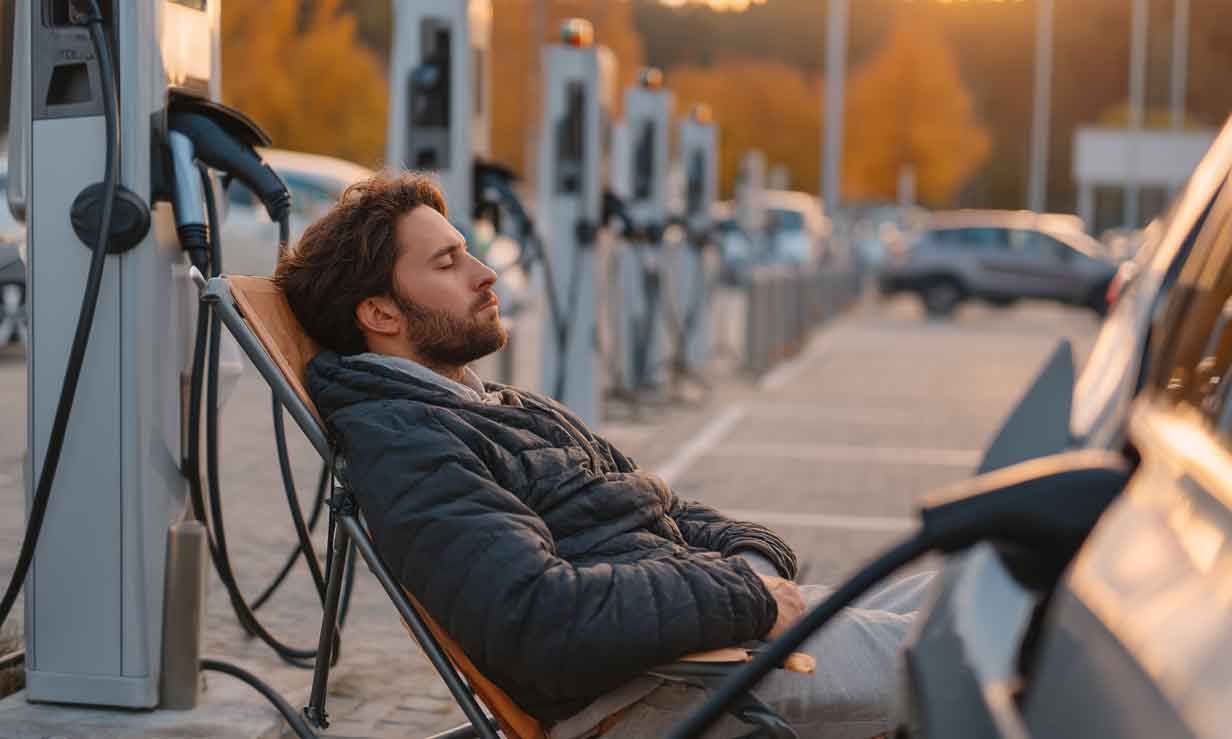
- A small camp chair. Sounds ridiculous until the first sunny charger next to a field, when you're reclining with a coffee and everyone at the gas station across the road is standing up pumping fuel. Worth it for the smugness alone.
- A real snack stash and a good water bottle. You're stopping every couple hours anyway — make it a picnic, not a vending-machine surrender.
- Something to do with your hands or eyes. A downloaded show, a book, a podcast queued up. Twenty-five minutes is exactly long enough to be annoying if you're staring at the charge percentage and lovely if you're not.
- A walk. The single best one. Use PlugShare to favor chargers near a main street, a park, a coffee shop, a view. The difference between a charger behind a big-box store and one a block from a nice little downtown is the difference between enduring the stop and looking forward to it.
Plan the stops at decent places and the math takes care of itself while you're off being a person. That, weirdly, ends up being the whole argument for electric road tripping: it forces you to stop, often, in real places, for just long enough to enjoy them.
Let something else handle the math
The honest truth is that the best EV trip is one where the route, the charge stops, and the overnights are sorted before you pull out — so you can spend the drive enjoying the country instead of doing arithmetic at 70 miles an hour. That's the part I happily hand off now.
The charging-aware planning is exactly what RoadTripp's EV mode does — it paces your days around real charging stations the same way it paces fuel and overnights for everyone else. You can plan an electric trip in the browser today.