
I've made the mistake enough times to have stopped making it. The deserts of the Southwest in July, when the asphalt's hot enough to cook on. New England in November, after the leaves have dropped and before the snow's any fun. A mountain pass in a spring that turned out to still be winter up top. Every one of those trips would've been a knockout six weeks earlier or later. The destination was right. The timing was wrong, and timing is the whole game.
The good news is that this country is so big and so varied that something is always at its peak somewhere. The trick is just pointing the car at the right region for the season you're in. Here's how I think about the calendar.
Spring: chase the desert and the blooms
Spring belongs to the places that'll be unbearable in a couple of months. The desert Southwest is glorious from March into May — Joshua Tree, Saguaro down by Tucson, Big Bend on the Texas border — comfortable hiking weather before the furnace switches on. Time it right after a wet winter and you might catch a wildflower bloom that turns whole hillsides to color; California's deserts do it some years and people drive hundreds of miles for it.
It's also the window for the South before the humidity rolls in, the Texas hill country when the bluebonnets line the roads, and the Smokies, which are quietly one of the best wildflower shows in the country come April. Spring's the season to go low and go south, before summer makes you pay for it.
Summer: go high and go north
Summer is the one season with a hard rule attached: get up high or get up north, and stay out of the desert. The low country bakes, but that same heat is exactly what finally opens the high country. Glacier's Going-to-the-Sun Road usually isn't plowed clear and fully open until sometime in July — all that snow takes that long to clear — and once it is, the northern Rockies are about as good as driving gets.
This is the season for the Rockies and the Tetons, the Cascades and the Pacific Northwest, the Oregon coast, the High Sierra, the Great Lakes and Michigan's shoreline, the Maine coast, and the big one — Alaska and the Alcan, which really only makes sense in the long days of summer. Point the car at elevation or at a coastline and let everybody else sit in the heat.
Fall: the best road-trip season there is
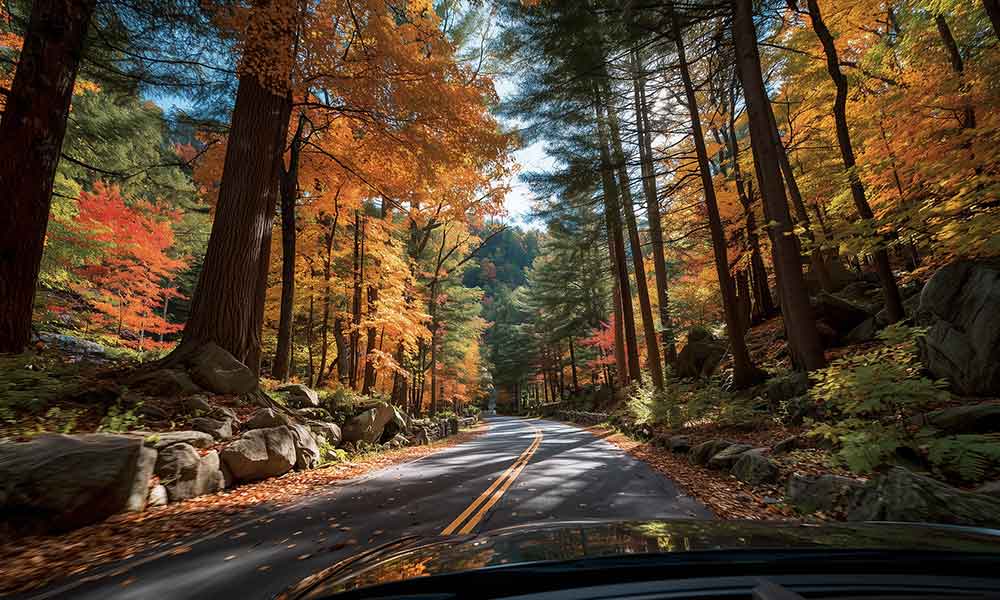
I'll just say it plainly — fall is the finest time to take a road trip in America, and it isn't especially close. The crowds of summer go home, the kids go back to school, the heat breaks, the prices drop, and the whole country puts on a color show on its way to bed.
New England gets the headlines, and earns them, with peak foliage rolling north to south through late September and October. But the same magic runs down the Blue Ridge Parkway and through the Smokies, lights up the aspens in the Colorado Rockies around the end of September, and turns the wine country gold right at harvest. (We've since written it up region by region — when the leaves peak and the roads to be on — and, because fall is also when the high passes start closing, a field guide to seasonal road closures.) And here's the bonus: as fall cools things off, the desert Southwest comes back into play, so your window of good options is wider in autumn than any other time of year. If you can only take one big trip, take it in the fall.
Winter: point the car south
Winter is for going south and staying there. The desert parks that would kill you in July are at their absolute best — Death Valley in winter is mild, uncrowded, and otherworldly, and the same goes for Joshua Tree, Saguaro, and Big Bend. The Gulf Coast and Florida, the Southern California coast, the low Arizona desert around Phoenix and Tucson — all of it comes alive while the north is frozen.
The rule for winter is mostly about what to avoid: the mountain passes and the high country, where the roads get dicey or close outright and a trip can turn into a survival exercise in a hurry. Unless you're deliberately chasing snow for a ski town — which is its own fine kind of road trip — keep the route low and keep it south, and winter becomes a season for driving instead of one to wait out.
The real sweet spot: the shoulders
If you take one thing from all this, take this. The very best weeks to travel are the shoulders — late spring and early fall, the hinges between the seasons. You get the better weather without the peak crowds, the lower prices without the place being shut down for the off-season, and the roads and the trails and the towns half to yourself. The same park, the same drive, the same coast, for less money and a fraction of the people, just by shifting your dates a few weeks off the obvious. It's the closest thing to a free upgrade that travel offers.
Let the calendar pick the place
So when the itch to go hits — and it always does — let the season make the first decision. Don't force a summer plan onto a place that's only good in October. Ask what's at its peak right now, point the car that way, and you've won half the battle before you've packed a bag.
Once you've got the where and the when, the rest is just routing — spacing the days, finding the stops, lining up the overnights so you arrive in time for the good light. That's the part I let the app handle. And if you want somewhere to start, our Epic Trips are sorted by region, so it's easy to find the one that fits the season you're itching to drive in.