
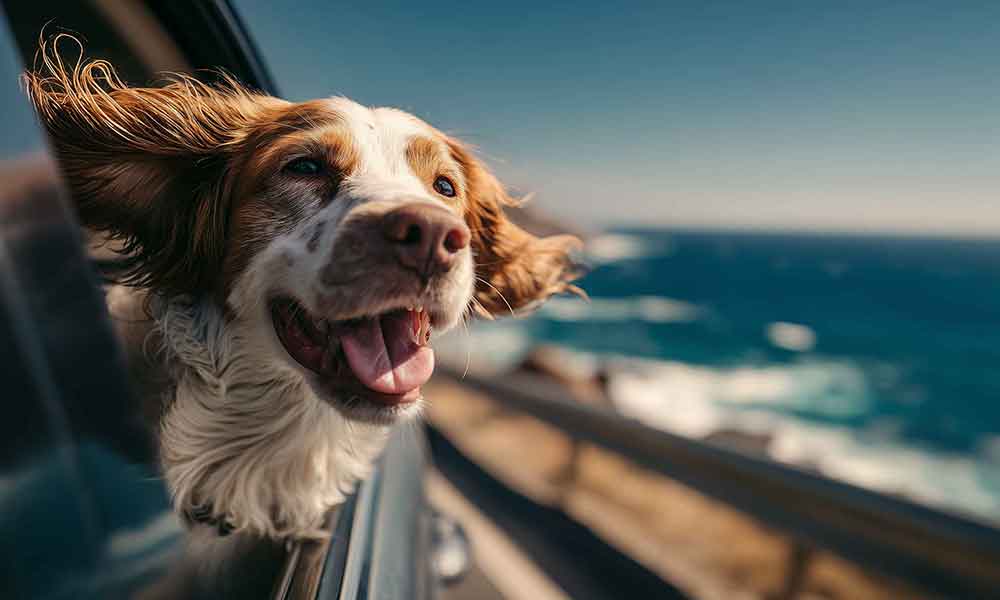
Before our first big road trip, I bought my dog Gus a crash-tested travel crate, a cooling vest, a GPS collar, a collapsible water fountain with a little recirculating pump, an elevated cargo platform, a doggie first-aid kit roughly the size of a carry-on, and a ramp, because his hips are seven but his soul is fourteen. I had spreadsheets. I had a gear checklist with sub-categories.
Gus wanted to put his head out the window. That's it. That was the whole agenda. Two thousand miles of bliss, ears flapping, eyes closed, the most fulfilled mammal in North America — while four hundred dollars of equipment rode quietly in the back, unused, judging me.
So consider this the report from a man who over-bought everything once so you don't have to. Here's what actually matters, what to skip, and where the two of you can sleep when the driving's done.
First, the honest part: does your dog actually like the car?
This is the question everybody skips and it's the most important one. A road trip works beautifully if your dog loves car rides — and the good news is most of them do. To a lot of dogs the car is a magic box that smells like adventure and sometimes ends at a lake. Those dogs are born for this.
But some dogs get carsick, and here's the part I want to be straight with you about. If you already know your dog reliably gets sick or panics in the car, do not bet a thousand-mile trip on the idea that they'll "get used to it" along the way. They mostly won't, not on the trip itself, and you'll spend the whole drive cleaning the back seat at rest stops and feeling like a monster.
There's nuance worth knowing. Puppies get carsick more than adults because the balance system in their inner ear isn't finished cooking yet — a lot of them genuinely outgrow it between six months and a year. And an adult dog who's just under-practiced can often improve with short, positive trips in the weeks beforehand: sit in the parked car with treats, then down the driveway and back, then around the block, then a happy drive that ends somewhere great. Build the association up gently and many dogs come around.
That's for the dog who's rusty. It's not a cure for the dog who's wired to be miserable in a moving vehicle. If that's yours, the kindest, sanest move might be a great sitter and a guilt-free trip. Love them enough to leave them home. Gus, for the record, would climb into a running cement mixer if he thought we were going somewhere.
Buckle the dog up (I learned this the embarrassing way)
An unrestrained dog is the one thing on this list that's genuinely dangerous, not just inconvenient. A loose dog is a distraction up front — there's research showing a loose pet more than doubles distracted-driving behavior — and in a hard stop, a sweet sixty-pound retriever becomes a sixty-pound projectile. For everyone in the car, including him.
Two good options:
- A crash-tested crate in the back. If your dog already loves their crate at home, this is a portable safe room, and it's wonderful. Mine ride better crated than any other way.
- A seat-belt harness that clips into the buckle — and make sure it's a real crash-rated travel harness, not a walking harness with a clip zip-tied on. Back seat, never the front.
The back of the vehicle is the safe zone. And please, I'm begging on behalf of every dog I've ever seen white-knuckling a truck bed: no riding loose in an open pickup. It's how an enormous number of dogs are hurt every year, and it's entirely preventable.
The kit that actually earns its place
After Gus's gear-hauling humiliation tour, here's the short list that does real work. Notice how cheap most of it is.
- Water from home, and a collapsible bowl. This one surprised me — strange water can upset a dog's stomach, so I bring a couple of jugs from the home tap and refill from those. Offer water at every single stop.
- Their normal food, measured out. Do not switch foods right before a trip. If you're changing diets, do it gradually in the weeks before, or you'll be discovering new things about your dog's digestion at 70 miles an hour.
- Waste bags. More than you think. Then more.
- Leash, plus a backup leash. A long line is great for rest stops.
- Any meds your dog takes. And if your dog gets anxious or queasy in the car, it's worth a quick word with your vet beforehand — there are real options, from calming aids to anti-nausea meds.
- A small first-aid kit — and yes, mine is now reasonably sized, thank you.
- A familiar blanket or toy. Their bed smelling like home does more for travel nerves than any gadget I bought. The recirculating water fountain did not make the cut.
- A towel or two. Muddy paws, lake days, surprise rain. Always.
Stop more than you think — and tire him out first
Plan to pull over every two to three hours for water, a sniff, a short walk, and a bathroom break. Puppies and seniors need it more often. It's the same rhythm kids need, which is convenient if you've got both, and it keeps a dog from getting stiff, stressed, or queasy.
Three things that quietly make or break the day:
- Tire him out before you leave. A long walk, a hard play session, a romp at the dog park the morning of departure. A tired dog sleeps; a fresh dog editorializes. This is the single best trick I know.
- Go easy on food before driving. A big meal right before you roll is a recipe for a carsick dog. Smaller amounts spread across the day sit much better. Feed the big meal when you've stopped for the night.
- Never, ever leave a dog in a hot car. Not for "just a minute." The temperature inside climbs faster than anyone believes, and it kills dogs every summer. If nobody can stay with him in the air conditioning, he comes in with you or the errand waits. This one isn't negotiable.
Where to sleep: hotels that'll have you
The good news for the modern dog traveler is that a lot of chains genuinely want your business. A few that have reliably taken care of Gus and me:
- Motel 6 — the budget standby and still one of the most consistently dog-friendly chains going. Up to two pets, no size drama, and no pet fee. "We'll leave the light on" includes the dog.
- Red Roof Inn — one well-behaved dog stays free at most locations, and they'll often knock a little off the rate to boot.
- Kimpton — the fancy option, and worth it. Any pet, any size, any breed, no fee, and they go all in: a dog bed, bowls, treats at check-in, sometimes an actual pet happy hour. Gus has never felt more seen.
- Drury Hotels — two pets free, plus free breakfast and an evening reception for the humans. Solid all around.
- La Quinta — long a road-tripper's friend; since the Wyndham buyout many locations now charge a modest fee (often around $20 a night), so it varies more than it used to. Still widely pet-friendly and everywhere.
- Best Western — over 1,600 pet-friendly properties, though fees and size limits vary by location (figure somewhere in the $15–45 range).
One hard-won rule: franchise locations set their own pet policies, so confirm it when you book, not when you arrive. The brand website, the listing, and the clerk at the desk do not always tell the same story, and 10pm with a tired dog is a bad time to find that out. A finder like BringFido is handy for sniffing out the specifics and the independents.
Where to sleep: campgrounds and KOA
If your trip leans outdoorsy, campgrounds are where a dog really gets to be a dog. KOA is the easy default — 500-plus locations across the U.S. and Canada, and a lot of them are right off the highway (the KOA Journey sites in particular are built for pulling in after a long day). Most importantly, many have Kamp K9 off-leash dog parks — fenced runs with water and cleanup stations where your dog can finally sprint after eight hours of riding shotgun. And if you're not a tent person, plenty of KOAs rent cabins that take dogs.
A few things to know before you book a campsite anywhere:
- Leashes are required outside the off-leash areas — KOA's rule is six feet max. Bring it.
- Public land isn't all one rule. National parks mostly hold dogs to roads, campgrounds and paved paths, and the big western parks keep them off the trails; national forests and BLM land are a good deal easier going. Our public-lands field guide has the dog rule for each kind of land.
- Some individually-owned locations have breed restrictions (often the usual insurance-driven list), so if you've got a pittie, a rottie, or a doberman, call the specific campground ahead.
- A barker won't last. A dog that howls all night gets you politely asked to find other arrangements — fair enough. If yours isn't settled in a new place, a crate and that home-smelling blanket help a lot.
Just go (slowly)
Here's the real secret, the thing all my gadgets were trying and failing to buy: with a dog, the trip itself slows down, and that turns out to be the whole point. You stop more. You walk more. You notice the field behind the rest area because somebody had to go smell it. The mindset that makes it work is simply we'll get there when we get there.
Plan the route so the stops, the overnights, and the daily mileage are sorted before you pull out — that's the part I let the app handle now, so I can spend the drive being Gus's chauffeur instead of his logistics department. Pack the short list. Buckle him up. Roll the window down a couple inches.
He's already got his head out of it.